

Is Tyrant worth it for djent and prog metal in 2026?
Yes—TYRANT is worth considering for djent and prog metal in 2026 when tight low end and precise pick attack are your main rhythm-guitar requirements. Its SATN voice directly targets those qualities, but the amp sim cannot fix an uneven DI performance or replace a separate plan for clean passages and ambient effects.
- Is Tyrant amp worth it? Yes, for djent rhythm work that prioritises tight low end and precise pick attack.
- Oracle Sound's TYRANT amp sim offers SATN and TRSH voices, with BOOST available on both.
- Judge palm mutes, chord separation and sustained notes against bass and drums—not just a soloed guitar.
- Keep your existing amp sim if it already delivers the attack and mix placement your songs need.
Is TYRANT worth it for djent and prog metal in 2026?
Oracle Sound's TYRANT amp sim is best for metal producers seeking tight low end and precise pick attack from the SATN voice. TYRANT puts SATN and TRSH on one AMP switch, with BOOST available on both. That makes it a focused candidate for rhythm-heavy productions rather than a reason to replace every guitar processor in your session.
The strongest supporting detail is specific: SATN is described around low-end control and picking precision. Those are relevant priorities for syncopated palm mutes, low-string accents and riffs that alternate between silence and hard attacks.
Use this decision sequence before adding another amp sim:
- Identify the problem. Decide whether your current rhythm tone lacks attack, carries too much low-end bloom or simply needs a different character.
- Choose a representative DI. Include muted notes, open chords, rests and sustained notes from an actual song.
- Compare at matched loudness. Do not let a louder output decide which amp sounds better.
- Listen in the arrangement. Keep bass and drums playing while judging the guitar's place.
- Keep the purchase conditional. Choose TYRANT only if it solves the production problem you identified.
Why this matters
Djent rhythm tone needs more than distortion. You need the start of each note to remain readable while the low string, bass and kick occupy the same arrangement.
Prog metal adds another demand: the guitar sound must survive changes in density. A tone that works beneath a sparse riff still needs to hold its place when the drums open up or the bass becomes more active.
An amp sim is one part of that system. Record-ready guitar tones come from the performance, gain structure, cabinet sound and arrangement working together. Replacing the amp stage without checking those other parts leaves the diagnosis unfinished.
SATN: best for attack-focused rhythm evaluation
Start with SATN when your priority is tight low end and precise pick attack. Those qualities are explicitly part of TYRANT's product description, making SATN the most defensible starting point for this use case.
Begin without BOOST engaged. Establish the core sound, then compare BOOST at matched output level so you hear its effect rather than a volume difference.
Use enough gain to connect sustained notes, then reduce it until the muted passages become easier to follow. Treat this as an audition method, not a prescribed preset: pickup output, playing strength and the DI level all affect how a distorted signal responds.
The limitation is straightforward. A description of tight low end does not establish how your lowest tuning, string gauge and picking technique will behave together. Test the actual guitar you record.
TRSH: best for comparing the second amp voice
TRSH gives you another voice on the same AMP switch. The supplied product description does not establish a detailed tonal contrast with SATN, so do not assume TRSH is automatically darker, looser or more suitable for leads.
Replay the same DI through TRSH without changing the rest of the session. Match the output level, then compare note starts, chord separation and decay.
The benefit is a second voicing within TYRANT. The trade-off is that another option only matters if it contributes something you use; a second voice that never survives your mix comparison adds no practical value to your workflow.
Why TYRANT's usefulness varies between sessions
A focused amp sim earns its place by solving a repeatable problem. These factors determine whether TYRANT fits yours:
- Rhythm-tone target: SATN's stated low-end control and pick precision align with attack-focused rhythm work.
- Need for different voices: TYRANT offers SATN and TRSH, but you still need to establish which voice serves each arrangement.
- BOOST use: BOOST is available on both voices; compare it deliberately rather than treating it as a mandatory setting.
- Existing processing: If your current amp sim already provides the required attack and separation, another plugin needs a distinct role.
- Song requirements: A high-gain rhythm solution does not, by itself, establish a complete clean, ambient and lead workflow.
For a 2026 buying decision, define the missing capability before comparing product names. That keeps the decision tied to a session problem instead of a growing plugin folder.
How does TYRANT compare with other amp-sim directions?
These are different production targets, not a ranking of sound quality. The comparison uses the stated product roles rather than unsupported claims about realism, latency or CPU use.
| Amp sim | Best for | Stated design | Benefit for this decision | Limitation for this decision |
|---|---|---|---|---|
| TYRANT | Attack-focused metal rhythm | SATN and TRSH voices; BOOST on both | SATN explicitly targets tight low end and precise pick attack | Does not establish a complete clean and ambient workflow |
| SLAMP | Slam, brutal death metal and deathcore weight | SOLID STATE or TUBE options; thick, dense tonal target | Relevant when density is the production goal | Its stated emphasis is weight, not specifically djent articulation |
| CATAMP | Sessions spanning pop-punk crunch and aggressive metal | Two CAT-inspired channels, HELL and BAD | Relevant when mid-to-high-gain range matters | Its stated range does not establish better low-tuned attack than TYRANT |
Choose by the job, not the genre label alone. A prog arrangement built around articulate high-gain rhythm presents a different problem from a slam track built around dense sustained weight.
For Oracle Sound amp sims in 2026, the useful distinction is the stated production target. TYRANT addresses the attack-focused question most directly through SATN; that is a reason to evaluate it, not proof that it wins every mix.
Build a controlled DAW comparison
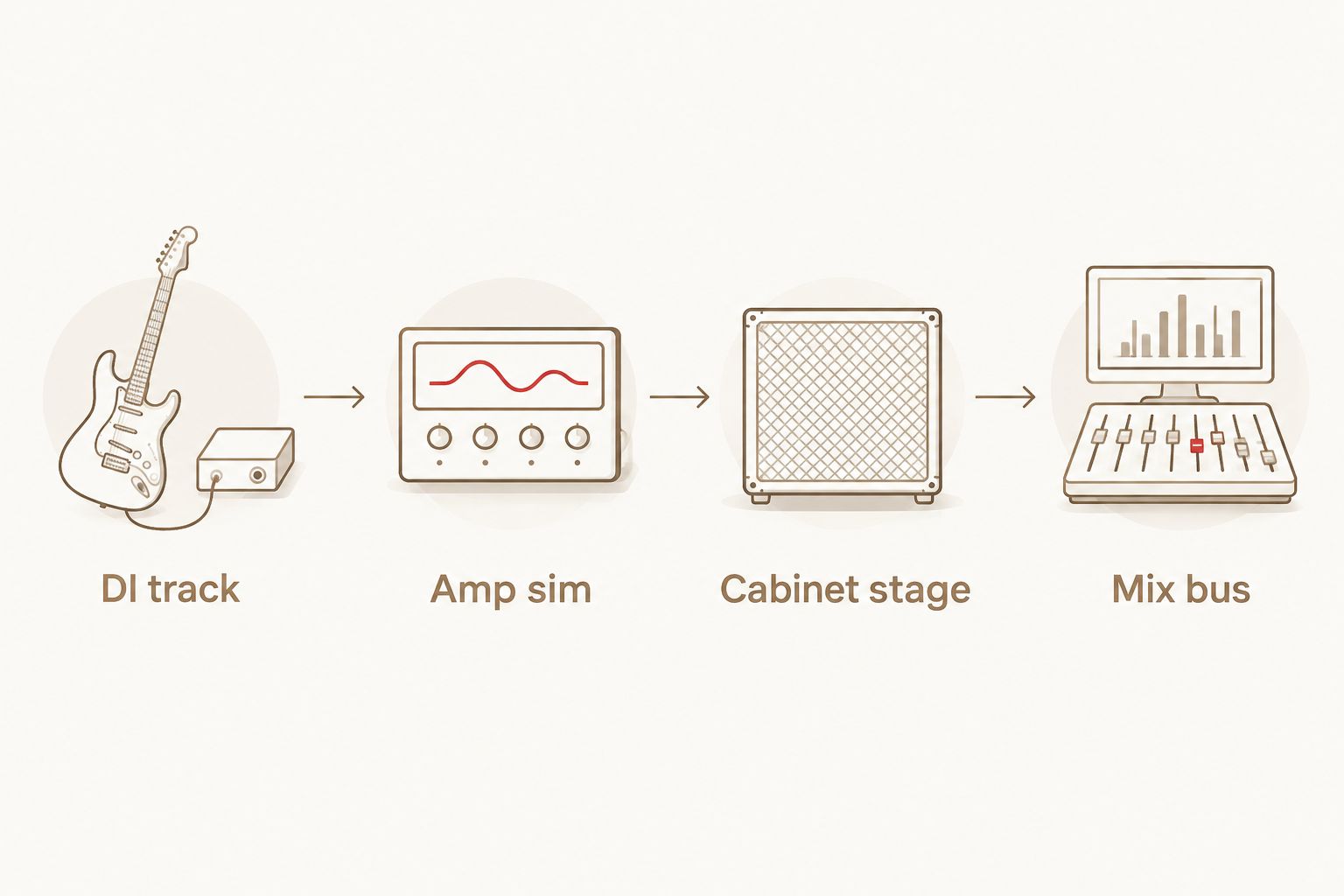
Use a repeatable signal chain: DI track, amp sim, cabinet stage, mix bus. Retain the cabinet processing already provided by your setup, and avoid accidentally adding another cabinet stage without intending to.
The comparison needs to separate the amp's contribution from everything around it. Keep the DI performance and downstream processing unchanged while you make the initial voice decision.
DI track
Record a dry performance that contains the difficult parts of the song, not just the easiest chug. Include a low-string stop, a moving chord shape and a note that rings beyond the next drum hit.
Listen to the DI before processing. Buzz, unwanted string noise and inconsistent muting need attention at the source; distortion does not turn them into controlled articulation.
Amp sim
Select SATN first, then compare TRSH using the same passage. Leave BOOST off for the initial comparison, then repeat with BOOST engaged.
Adjust one control at a time. If you change input level, gain, voicing and cabinet processing together, you lose the ability to identify what improved the sound.
Cabinet stage
Keep the cabinet sound consistent while comparing amp voices. Afterwards, evaluate the cabinet stage separately against the full arrangement.
Avoid judging the amp through a cabinet sound you already dislike. A harsh or congested result needs a signal-chain check before it becomes a verdict on TYRANT.
Mix bus
Keep the comparison at matched loudness with bass and drums active. Listen for the guitar's attack and pitch, not simply its size when soloed.
Use the same saved passage for future comparisons in 2026. A consistent source makes it easier to recognise whether a new tone solves a problem or merely sounds unfamiliar.
Test the rhythm part before the lead sound
A sustained lead can flatter a high-gain tone while revealing little about stop-start rhythm control. Start with the part that exposes the weakest link.
On palm mutes, listen for a clear note start followed by a controlled body. On open chords, check whether the pitch movement remains understandable once the bass enters.
Then test the rests. Unwanted ringing between accents often makes a tight riff feel less defined, even when the amp tone itself has a sharp attack.
Finally, play the sustained section. Reducing gain until every chug sounds dry is not a win if the same setting makes the song's longer notes fall apart. Save separate rhythm and sustained-part settings when the arrangement demands different responses.
Does TYRANT replace your physical amp?
TYRANT addresses software-based guitar processing; a physical amp also belongs to a monitoring and playing setup. Separate those decisions before removing hardware from your rig.
For a producer considering selling your old amp, the decisive test is whether the software chain also supports the way you track, rehearse and monitor—not whether one rendered riff sounds convincing. Keep the hardware decision separate from the tone comparison until the replacement workflow works in practice.
Evaluate the monitored signal while playing, then listen back without performing. Those are different checks: the first concerns your recording workflow, while the second concerns what the production actually contains.
Do not infer a latency or system-performance result from TYRANT's tonal description. Confirm the current requirements against your computer, interface and DAW before making it central to a session.
When should you keep your existing amp sim?
Keep your current amp sim when it already gives the song controlled low end, readable attacks and the required sustained tone. TYRANT needs a specific role beyond being another high-gain option.
Before replacing anything, replay the DI with less gain and reassess the cabinet stage. Also check whether the kick and bass arrangement is hiding the guitar's attack.
Choose a different direction when your main requirement is outside the stated high-gain role. A session centred on clean modulation or spacious ambient guitar needs its own evaluation rather than an assumption that a metal amp sim covers everything.
For 2026 sessions, a smaller set of sounds you can place quickly is a better purchasing criterion than collecting overlapping options. The practical question is whether TYRANT makes a recurring production decision easier.
Can TYRANT cover an entire prog-metal arrangement?
TYRANT can serve as the high-gain component of a prog-metal arrangement, but its stated features do not establish every sound the arrangement needs. Plan clean sections, ambience and lead effects separately.
Should you always engage BOOST for djent?
BOOST is available on both TYRANT voices, but it is not a mandatory djent setting. Compare it against the same DI at matched output level and retain it only when the result serves the riff.
FAQ
Is Tyrant amp worth it for djent?
TYRANT is worth considering for djent when tight low end and precise pick attack are your priorities. SATN explicitly targets those qualities; judge the result using your own DI against bass and drums.
What's the best TYRANT voice to start with for prog-metal rhythm?
SATN is the clearest starting point for attack-focused prog-metal rhythm because its description specifies tight low end and precise pick attack. Compare TRSH afterwards using the same performance and matched loudness.
Does TYRANT have BOOST on both amp voices?
TYRANT has BOOST available on both SATN and TRSH. Compare each voice with BOOST off and on before deciding which setting belongs in the song.
Will TYRANT fix muddy low-tuned guitars?
TYRANT alone does not fix every cause of muddy low-tuned guitars. Check the DI performance, gain structure, cabinet processing and bass arrangement before changing the amp stage.
Is TYRANT better than SLAMP for prog metal?
TYRANT's SATN voice is more directly aligned with an attack-focused requirement, while SLAMP's stated target is thick, dense weight for slam, brutal death metal and deathcore. That difference supports a use-case choice, not a universal quality ranking.
Do I need another distortion plugin before TYRANT?
A separate distortion plugin is not a prerequisite established by TYRANT's stated features. Start by evaluating its amp voices and built-in BOOST before adding another gain stage.
Should I buy TYRANT if I already own a metal amp sim?
Buy TYRANT only when it fills a defined gap in your existing metal-guitar workflow. Keep your current setup if a matched-level comparison shows no useful improvement in attack, separation or tonal fit.
One last thing
Listen to the rests as closely as the chugs. A rhythm tone that sounds enormous during a sustained note still needs to leave deliberate space between accents.
Choose Oracle Sound's TYRANT amp sim for a defined rhythm-guitar job—not as a substitute for tight tracking. Save the dry DI so you can revisit the tone without recording the performance again.


