

NAM Profiles for Music Production Students (2026 Guide)
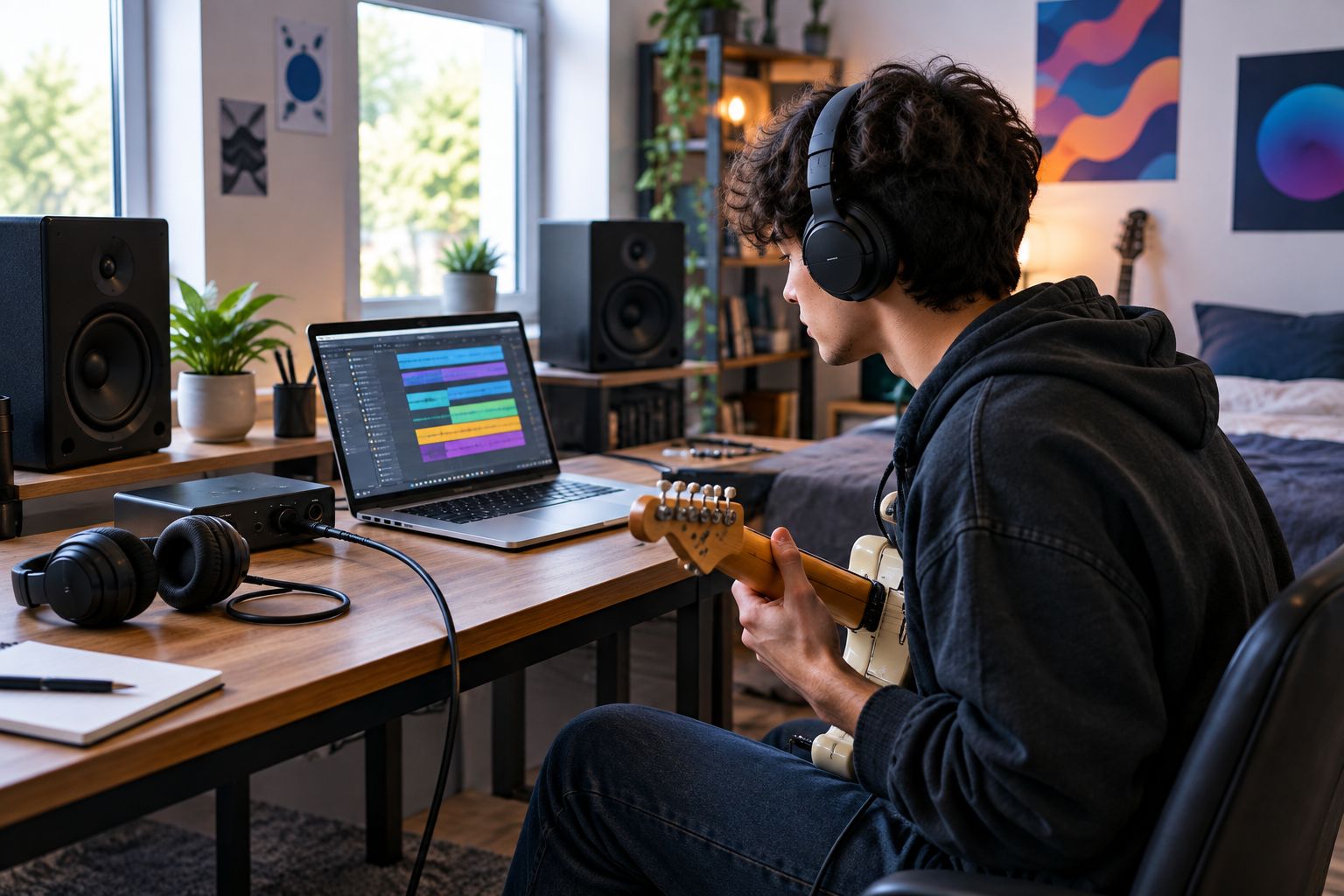
NAM profiles for music production students are Neural Amp Modeler capture files that reproduce a specific amp, pedal, and cab chain without a live room, a mic, or a landlord who tolerates 100dB at midnight. A student on a laptop and an interface can load a captured metalcore rig or a doom-and-sludge stack in seconds, which matters when the assignment is due Friday and the rehearsal space is booked solid.
- NAM profiles for music production students swap a mic'd amp room for a free plugin load — same tone, zero rehearsal space.
- Oracle Sound ships genre NAM packs: TONECTOMY for brutal high gain, ALL THE SMALL TONES for punk and pop-punk briefs.
- Gain-stage your DI signal before the profile, not after — clipping into a NAM capture is the most common student mistake in 2026.
- Free NAM captures cover practice takes; producer-made packs fix inconsistent tone matching across a full EP or demo reel.
- Reamping a DI take lets you swap profiles after tracking — critical when a lecturer asks for a different tone.
Why NAM profiles matter for music production students
You don't need to understand tube bias, negative feedback loops, or cab resonance to run a NAM capture — the profile handles the amp modelling, and you handle the mix. That distinction is the whole reason beginners can use NAM profiles without gear knowledge: the learning curve moves from soldering and biasing to gain-staging and file management, which is a curve a student juggling coursework can actually climb in a weekend.
Students also face constraints working engineers don't: shared dorm walls, one interface between three roommates, and assignments graded on genre accuracy, not personal taste. A NAM profile built for beatdown hardcore won't pass as a doom tone, and a lecturer marking a genre-study assignment will hear the mismatch immediately. Picking the right capture matters as much as running it correctly.
How to use NAM profiles for coursework and demo tracks
Install a free amp sim before buying anything
Start with the free, open-source Neural Amp Modeler plugin (VST3, AU, and CLAP formats) and a handful of community captures before spending on a pack. This is the cheapest way to learn how DI recording and profile loading actually behave in your DAW.
- Download the NAM plugin and confirm it loads in your host without crashing
- Grab a few free public captures to test loading and switching
- Record a short DI guitar pass with no effects before adding the plugin
- Set your buffer size low (64–128 samples) for tracking, then raise it for mixing
- Print the DI signal to its own track every time, even on a test take
Build your gain-staged signal chain
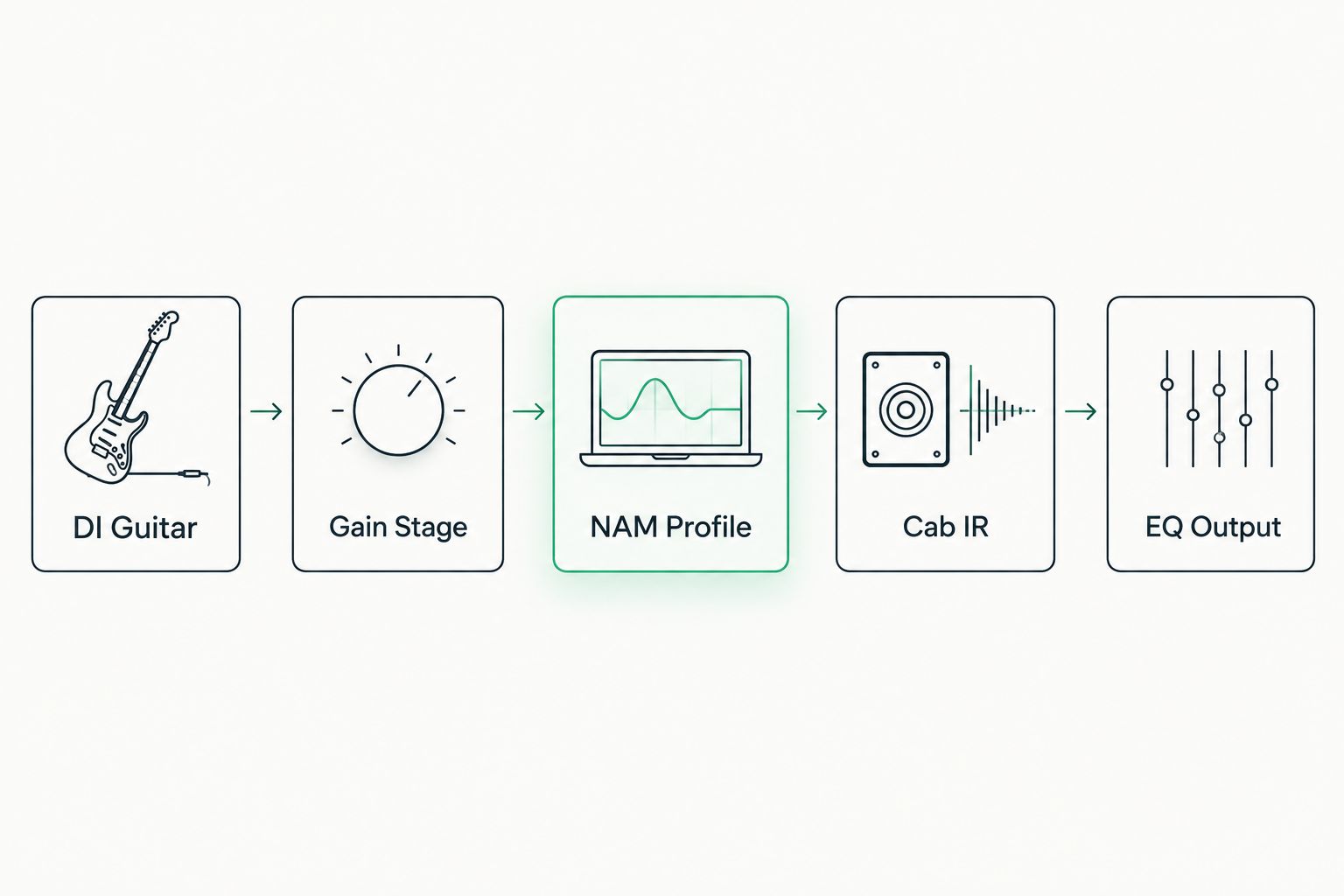
Most bad-sounding NAM captures aren't a bad profile — they're a hot or weak DI signal hitting a neural network trained on a specific input level. Get your gain staging right before you touch tone shaping.
- Record your DI guitar signal around -18dBFS peak, not hotter
- Load the NAM profile first in the chain, before any EQ or compression
- Add a cab IR loader only if the capture doesn't already include one
- Apply a noise gate after the profile if the amp model runs high gain
- EQ and compress after the profile, never before it
Match profiles to the genre brief
A metalcore assignment and a pop-punk assignment need different amp characters, and swapping a random free capture in for either one is the fastest way to lose marks on tone accuracy.
- High-gain metalcore or deathcore brief: reach for TONECTOMY, built around high-gain amps like the Diezel VH4 and ENGL Powerball
- Punk or pop-punk brief: ALL THE SMALL TONES is voiced for mid and low gain, articulate tones instead of wall-of-gain distortion
- Doom, sludge, or stoner brief: SUNEATER is built for low-tuned, heavy riffing rather than tight palm-muting
- Multi-genre coursework: a broad high-gain pack like VIC AUDIO METAL 2 NAM covers several amp captures in one file set


Reamp your DI takes for revisions
A lecturer asking for a different amp character after grading shouldn't mean re-recording the guitar part. This is the single biggest workflow advantage NAM profiles give students over a live rig.
- Keep the raw DI track muted but present in every session file
- Duplicate the DI to a new track for each revision instead of overwriting
- Bounce each version with a clearly different profile name in the file title
- Never print a profile's output without a DI backup sitting underneath it
- Note the exact profile and gain setting used in a text file per project
The DI track is your insurance policy — the profile is just today's opinion on tone.
Organise and back up your session files
Coursework gets marked on the file you submit, not the one you meant to bounce. Sloppy naming loses more marks than a mediocre tone choice ever will.
- Name sessions and bounces with assignment number, date, and profile used
- Keep NAM captures in one dedicated sample/plugin-data folder, not scattered across drives
- Back up the full session before bouncing a final version
- Lock plugin latency compensation settings before final mixdown
- Version-number your DAW project file so the wrong bounce never ships
Move to purpose-built packs when free captures run out
Free community NAM captures on sites like ToneHunt are inconsistent — gain staging, mic placement, and cab choice vary file to file, which is fine for practice but a liability on a graded mix. Producer-captured packs solve that by locking gain structure and cab pairing across every file in the set, so switching between profiles in one project doesn't mean re-gain-staging every track.
NAM profile options for students compared
| Option | Best for | Format | Key limitation |
|---|---|---|---|
| Free community NAM captures | Practice takes, ear training | NAM (.nam) | Inconsistent gain-staging and cab pairing between files |
| TONECTOMY | High-gain metalcore/deathcore assignments | NAM | Not suited to clean or crunch tones |
| ALL THE SMALL TONES | Punk and pop-punk coursework | NAM | Too low-gain for extreme metal briefs |
| SUNEATER | Doom, sludge, stoner projects | NAM | Narrow tonal range outside that genre |
| Hardware amp and mic | Live-room assignments, thesis recitals | N/A | Needs a treated room and mic technique most students don't have access to |
Verdict: for genre-accurate coursework in 2026, a producer-captured NAM pack matched to the assignment brief beats a random free capture almost every time — the consistency across files is what actually saves grading time.
Common mistakes music production students make with NAM profiles
- Loading a profile without gain-staging the DI first, then blaming the plugin for a bad-sounding capture
- Submitting only the processed output track with no DI backup, so any requested revision means re-recording guitar
- Downloading a random free capture with no genre match to the brief, then fighting an unrelated amp voicing with EQ
- Tracking at a large buffer size, which adds latency and kills playing feel during the actual take
- Skipping file naming and version numbers, then submitting the wrong bounce for grading
FAQ
What are NAM profiles?
NAM profiles are capture files made with Neural Amp Modeler, a free plugin that reproduces the tone of a specific amp, cab, and mic setup. You load a NAM file over a DI guitar signal instead of recording a physical amp.
Are NAM profiles free for music production students?
The core Neural Amp Modeler plugin and many community captures are free. Producer-made packs such as Oracle Sound's TONECTOMY or ALL THE SMALL TONES add genre-matched, consistently gain-staged captures on top of the free option.
Do I need expensive gear to use NAM profiles?
No. You need an audio interface, a DI guitar signal, and the NAM plugin. The profile itself replaces the amp, cab, and microphone entirely.
Which NAM pack fits a metal assignment?
TONECTOMY covers high-gain metalcore and deathcore briefs with captures from amps like the Diezel VH4 and Bogner Uberschall. For lower-tuned doom or sludge work, SUNEATER is the closer genre match.
Can I use NAM profiles for a punk or pop-punk brief?
Yes. ALL THE SMALL TONES is voiced for mid and low gain, punchy tones instead of high-gain distortion, which fits punk and pop-punk assignments better than a metal-focused pack.
Do I still need a cab IR with NAM profiles?
It depends on the capture. Many NAM files bundle the amp, cab, and mic in one profile, while amp-only captures need a separate impulse response loader after the plugin.
Is a NAM profile the same as a TONEX profile?
No. NAM (Neural Amp Modeler) is a free, open-source plugin format, while TONEX profiles run in a separate paid ecosystem. The two file types aren't interchangeable.
Why does my NAM profile sound different from the demo?
Mismatched input gain is the usual cause. Most profiles are trained on a specific DI level, so a hotter or weaker signal than that reference will shift the tone away from the demo you heard.
One last thing
Print your DI track every single session, even when you're only testing one profile. The moment a lecturer asks for a different amp character, you re-run the profile in seconds instead of re-tracking the part — that one habit saves more assignment deadlines than any single NAM pack does.