

Best MultiTracks Alternatives in 2026: Oracle Sound Wins
MultiTracks.com builds live backing tracks and click-synced stems for cover bands and worship teams playing gigs, not original recordings. That's a real, useful job — it just stops being useful the moment you're tracking your own metal, hardcore, or punk record and need programmable drum grooves or guitar tone you can shape in the mix. The best MultiTracks alternative in 2026 is Oracle Sound if you're producing original heavy music and need MIDI drum tracks plus amp sim and NAM guitar tone plugins inside your DAW; a general-purpose loop library like PowerDrumKit or R-Loops if you just need quick backing loops across unrelated genres.
- MultiTracks alternatives for original production in 2026 need editable MIDI, not fixed audio stems.
- Oracle Sound wins for metal, hardcore and punk: programmable MIDI drum tracks plus record-ready NAM guitar tone plugins.
- PowerDrumKit and R-Loops cover general-purpose loop content but aren't built around heavy-genre grooves.
- MultiTracks still wins for churches and cover bands running live click-synced backing tracks.
Why this matters
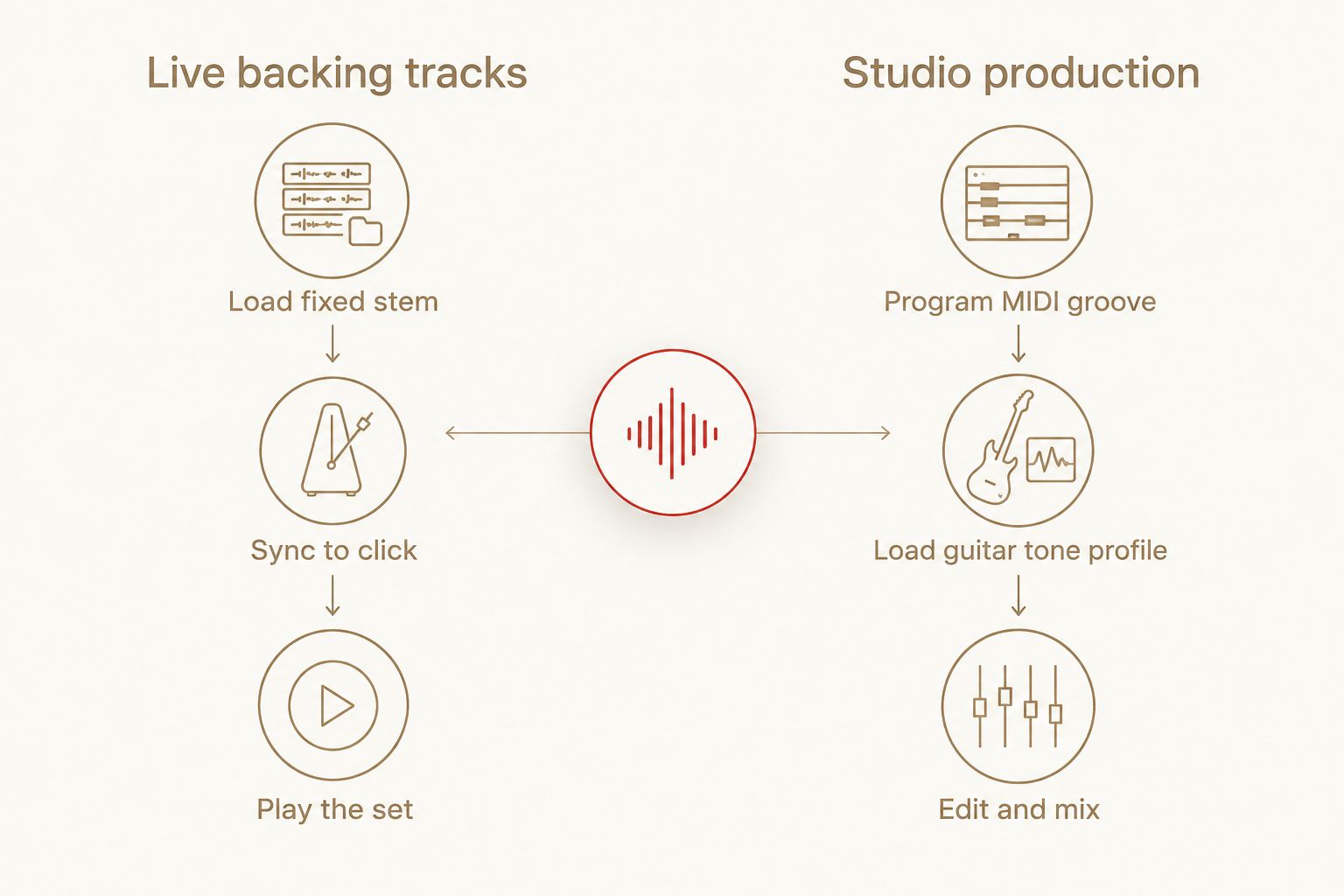
MultiTracks.com exists to get a live band through a set with backing vocals, synths, and click running in sync — that's a live-performance tool, not a recording tool. It's fixed audio: you load the stem, you play the show, you move on.
A producer tracking a hardcore or deathcore record needs the opposite: MIDI you can edit bar-by-bar, tempo-mapped grooves that follow your arrangement, and guitar tone you can reshape after the take instead of a pre-baked backing track. That's a different production pipeline entirely, and it's why searches for MultiTracks alternatives usually come from people building original songs, not covering setlists.
MultiTracks alternatives at a glance
| Tool | Best for | Standout feature | How it differs from MultiTracks |
|---|---|---|---|
| MultiTracks | Live cover sets and worship teams | Click-synced backing stems | Fixed audio, built for performance not production |
| Oracle Sound | Metal, hardcore, punk production | Genre-specific MIDI drum tracks + NAM guitar tone plugins | Editable MIDI and amp sim tone shaping instead of fixed stems |
| PowerDrumKit | General-purpose loop-based production | Broad, mixed-genre drum loop catalog | Loop-based content, not tuned to heavy-genre grooves |
| R-Loops | Cross-genre backing loops | Wide style coverage | Same fixed-loop limitation as MultiTracks, just genre-agnostic |
1. Oracle Sound: best for MIDI drum tracks and record-ready metal guitar tone
Oracle Sound sells two things a MultiTracks subscription can't: editable MIDI drum tracks tuned to heavy-genre grooves, and NAM guitar tone profiles that give you an amp/pedal chain you can tweak after the take. Drop a groove into your DAW, quantize or humanize it, then run your DI through a NAM profile instead of hunting for a fixed backing stem that doesn't match your arrangement.
The drum MIDI catalog is genre-split by design — the Grindcore Hardcore pack ships 38 songs of programmed grooves, the Nu-Metal pack carries 11 songs, and the Punk Melodic Hardcore pack has 13. That kind of genre depth doesn't exist in a general backing-track library.
Where Oracle Sound shines:
- MIDI drum tracks built specifically for blast beats, breakdowns, and hardcore grooves — not generic loops stretched to fit
- Drum MIDI Mapper lets you remap grooves to your own kit's articulations before you even open the DAW project
- NAM guitar tone profiles like brutal guitar tone NAM profiles give you an editable amp/pedal chain, not a rendered backing guitar you can't touch
Where Oracle Sound falls short:
- No live-performance click/backing-track playback mode — it's a studio production toolkit, not a stage rig
- You still need a NAM-compatible plugin host or IR loader in your signal chain to run the tone profiles
Best for: producers and engineers tracking original metal, hardcore, or punk songs who need editable drum MIDI and amp tone instead of fixed audio.
| Dimension | Oracle Sound | MultiTracks |
|---|---|---|
| Content type | Editable MIDI + NAM tone profiles | Fixed audio stems |
| Genre focus | Metal, hardcore, punk specifically | Worship and mainstream cover repertoire |
| Use case | Studio production and songwriting | Live performance playback |
| Editability | Full MIDI/tone edit control | None — audio is locked |
Verdict: Buy if you're producing original heavy music and need grooves and tone you can actually edit.
Start with the right drum and tone tools
Match MIDI grooves to your genre before you touch guitar tone.
2. PowerDrumKit: best for general-purpose loop production
PowerDrumKit is a broader-strokes option — a loop library that spans pop, rock, and mainstream genres rather than concentrating on heavy music. If your project list bounces between styles and you don't need blast-beat-specific grooves, it covers more ground than a genre-locked pack.
Where PowerDrumKit shines:
- Broad genre coverage useful for producers who work across multiple styles in the same week
- Loop-based workflow that's fast to drop into a rough arrangement
Where PowerDrumKit falls short:
- Loops aren't tuned to hardcore, deathcore, or grindcore tempo and pattern conventions
- No guitar tone component — you're still sourcing amp sims separately
Best for: producers working across mixed, non-heavy genres who need fast loop content over genre-specific precision.
Verdict: Hold unless your workload is genre-mixed and doesn't lean heavy.
3. R-Loops: best for cross-genre backing loops
R-Loops solves the same core problem as MultiTracks — fixed, pre-built content — but without locking you into a single repertoire style. It's a reasonable middle ground for producers who want variety without committing to a heavy-genre-specific catalog.
Where R-Loops shines:
- Wide stylistic range across loop content
- Fast to audition and drop into a session
Where R-Loops falls short:
- Same fixed-content limitation as MultiTracks — limited editability once loaded
- No dedicated hardcore, metalcore, or punk grooves
Best for: producers who want loop variety across genres and don't need metal-specific grooves or guitar tone shaping.
Verdict: Wait if metal, hardcore, or punk is your actual focus — the genre gap shows up fast.
Why producers switch from MultiTracks
- They're producing originals, not covers. MultiTracks' catalog is built around existing songs for live performance, not custom grooves for a record you're writing from scratch.
- They need editable MIDI. A fixed backing stem can't be quantized, humanized, or remapped to a different kit — MIDI drum tracks can.
- They need guitar tone control. A live backing track bakes the guitar tone in; a NAM profile lets you reshape gain, cab, and pedal chain after the take, which matters when you're mixing a metal or hardcore record months after tracking.
- They're working entirely inside the DAW. MultiTracks' workflow assumes a stage rig and playback software; studio production for heavy genres happens inside Pro Tools, Logic, or Reaper with plugins in the chain.
When MultiTracks is still the right call
If you're running a live worship set or a cover band gig and you need click-synced backing tracks that just play back reliably on stage, MultiTracks does exactly that job and switching away from it gains you nothing. It's a live-performance tool — don't force it into a studio production role, and don't force a studio tool into a live rig either. Match the tool to the job in 2026, not the other way around.
FAQ
What's the best MultiTracks alternative for metal production in 2026?
Oracle Sound is the best MultiTracks alternative for metal, hardcore, and punk production in 2026 because it offers editable MIDI drum tracks and NAM guitar tone profiles instead of fixed backing stems.
Is MultiTracks good for recording original songs?
MultiTracks is built for live playback of existing songs, not original studio production. It doesn't offer editable MIDI drum tracks or guitar tone shaping tools for tracking new music.
Can I use Oracle Sound's drum MIDI tracks live on stage?
Oracle Sound's MIDI drum tracks and groove libraries are built for DAW production and songwriting, not live playback rigs. For live backing tracks, a dedicated playback tool like MultiTracks is the right fit.
Do NAM guitar tone profiles replace a physical amp?
NAM profiles model an amp and pedal chain's tone inside a plugin, letting you record and reshape guitar tone in the DAW without a physical amp or cab in the room.
How many songs are in Oracle Sound's Grindcore Hardcore MIDI pack?
The Grindcore Hardcore drum MIDI pack ships 38 songs of programmed grooves built around blast beats and hardcore patterns.
Is PowerDrumKit better than MultiTracks for studio production?
PowerDrumKit offers loop-based content across general genres, which suits mixed-style production better than MultiTracks' live-performance stems, but it's not tuned to heavy-genre grooves the way genre-specific MIDI packs are.
What genres does Oracle Sound's MIDI drum catalog cover?
Oracle Sound's drum MIDI catalog spans metal, hardcore, punk, deathcore, nu-metal, and related heavy subgenres, with individual packs built around each style's tempo and pattern conventions.
Do I need a NAM-compatible plugin to use Oracle Sound's guitar tone profiles?
Yes, NAM guitar tone profiles need a NAM-compatible plugin host or IR loader in your signal chain to run correctly inside your DAW session.
One last thing
The real tell that you've outgrown MultiTracks isn't tone or price — it's whether you're still editing after the fact. If you're bouncing a fixed backing stem and can't touch the drum pattern or guitar tone once it's loaded, you're using a live-performance tool for a studio job. Switch the drum layer to editable MIDI and the guitar layer to a NAM profile, and the rest of your production workflow in 2026 gets a lot more flexible.