

Can I Use MIDI Drum Packs Commercially? Yes, If Licensed 2026
Yes, you can use MIDI drum packs in commercial releases when the pack’s licence permits that use and you follow its conditions. For a release in 2026, check both the MIDI pack licence and the licence for the drum instrument or sample library that produces the audio. Permission to release a finished song does not automatically include permission to redistribute the source MIDI files.
- Can I use MIDI drum packs commercially? Yes, when the applicable licence permits your intended release.
- Oracle Sound sells MIDI drum tracks and groove libraries; check the applicable terms before commercial delivery.
- Check MIDI permissions and drum sample permissions separately before exporting a finished track.
- Editing notes does not replace permission, and releasing audio differs from sharing source MIDI.
Is it legal to use MIDI drum packs in commercial releases?
The licence is the deciding document—not the file format, genre or amount of editing. A downloaded MIDI groove is not automatically cleared for commercial use simply because it contains no recorded audio. Buying a pack also does not establish every permission you need.
Separate technical compatibility from legal permission. The guide to using MIDI drum packs in a DAW addresses the production side; the applicable licence controls what you can release and deliver.
Use this sequence before putting a programmed drum performance into a commercial master:
- Identify the source. Record the pack name, supplier and files used in the session.
- Read the licence. Find permission covering your intended commercial use, including any restrictions or attribution conditions.
- Check the drum sounds. Review the terms for the virtual instrument, expansion or sample library that renders the MIDI.
- Check the deliverables. Distinguish a finished mix from isolated drums, an editable project and raw MIDI files.
- Keep the evidence. Save the applicable terms, purchase record and any written permission with your project archive.
Do not treat a product description as a substitute for licensing terms. If a description says a pack is designed for songwriting, that describes its purpose—not the full scope of commercial permission.
Why this matters for a heavy release
A beatdown groove can sit underneath guitars, bass and vocals in a finished master. The same groove can also sit exposed inside a downloadable DAW template. Those deliverables give the recipient different access to the underlying material.
For your 2026 release checklist, separate using a groove in music from supplying the groove itself. This distinction matters when you deliver work to a band, label, mixing engineer or tutorial customer.
The practical benefit of licensed MIDI is an editable performance: you can adjust kick placement, snare accents and cymbal choices around your riffs. The limitation is that creative control does not expand the licence. A rewritten breakdown still needs permission for any licensed material it retains.
Finished songs: check commercial music permission
For a commercial song, look for terms that permit incorporating the MIDI into a musical production and distributing the resulting recording. Check the wording against the release you actually plan: streaming, downloads, physical releases or commissioned music.
Do not substitute assumptions about the supplier’s audience. A pack marketed to professional producers still needs terms that support your use.
Best for: musicians releasing finished recordings under a licence that expressly covers their intended distribution. The production advantage is that you can build the drum arrangement inside your session; the legal limitation is that other uses remain subject to the terms.
A streaming release and a downloadable MIDI collection are not interchangeable. Permission for the first does not establish permission for the second.
Client sessions: check who receives the files
If you are programming drums for another band, decide what the client receives before building the arrangement. A stereo master, drum stems and a complete editable session are different handoffs.
Check whether the applicable terms address client work, collaborators, licence transfers or sharing source material. Do not assume that your purchase lets every recipient retain and reuse the original pack.
Best for: producers delivering an agreed recording or mix to a client. The advantage is a clear production handoff; the limitation is that an editable session can contain assets the client is not independently licensed to use.
For a 2026 client delivery, list the included assets in writing. Specify whether you are supplying rendered drums, your arrangement MIDI, original pack files or instrument presets. Keep permission questions separate from mix revisions.
MIDI resale and templates: check redistribution permission
Selling a groove library, sharing pack files with a collaborator or including them in a downloadable template requires a separate check. These uses expose the source material rather than only a finished musical recording.
Renaming files, changing tempo or moving a few notes does not establish redistribution rights. Neither does converting the files to another format.
Best for: source-file distribution only where the licence or separate written permission expressly allows it. Editable material is useful to the recipient, but that usefulness is exactly why you need to examine redistribution terms.
If the intended product is a drum-only loop collection, check permission for that use too. Rendering MIDI to audio does not automatically clear every kind of audio distribution.
Why commercial-use permission varies
There is no single licence attached to every MIDI drum pack. Review these factors against the terms supplied with the material:
- Intended use: a finished song, commissioned score, educational download and source-file collection are different uses.
- Delivered format: mixed audio, isolated drum stems, project files and raw MIDI expose different material.
- Licensed user: check who holds the licence and whether collaborators or clients need separate permission.
- Additional sounds: the MIDI licence does not replace the terms for the drum samples producing the recording.
- Conditions and exclusions: check attribution, redistribution, transfer and other restrictions rather than relying on a broad label.
Treat this as a reading checklist, not a claim that every supplier uses these restrictions. The actual terms govern your project.
Does royalty-free mean I can do anything with the pack?
No. Royalty-free describes a licensing arrangement; it does not mean unrestricted use, public-domain material or ownership of the source files.
Read what the licence permits and excludes. A royalty-free label alone does not answer whether you can sell the MIDI, share the pack or supply it inside a commercial template.
Do I need to change the MIDI before releasing a song?
Editing is not a universal legal requirement. Follow the applicable licence: if it permits the intended use without requiring modifications, do not invent an editing threshold.
Change the performance because the song needs it. For hardcore, that might mean matching kick accents to palm-muted guitars or replacing a busy fill before a stop. Those are arrangement decisions, not proof of permission.
Can I give the MIDI to the band that hired me?
Only give the band source MIDI when the applicable terms permit that handoff. Permission to produce a recording does not automatically establish permission to transfer the original pack or its files.
Agree on deliverables early. If source-file permission is unresolved, clarify it before promising an editable session.
Build the drum chain without mixing up the licences
Use a simple signal chain: MIDI track, drum instrument, audio render, drum bus. Each stage has a different job. The MIDI triggers the performance, the instrument supplies the sounds, and the rendered audio becomes part of your mix.
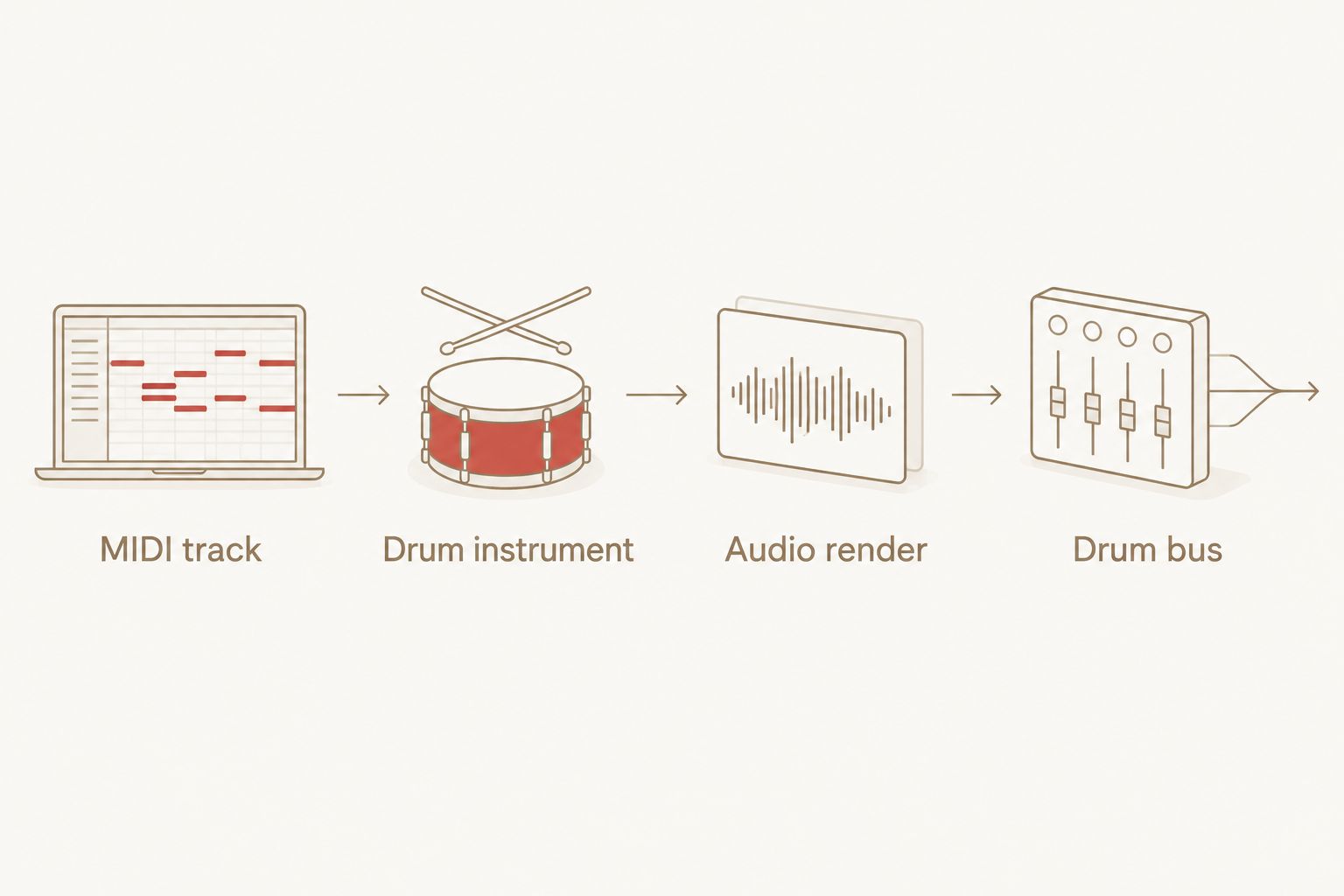
Start with the instrument’s drum map. Verify that kick, snare, tom and cymbal notes trigger the intended articulations before changing the groove. A misplaced cymbal hit is a mapping problem, not a licensing problem.
Then adjust velocity and timing around the riff. Keep the original source separate from your working arrangement so you can identify what you used. Do not describe humanising, remapping or quantising as legal clearance.
Before export, check these practical points:
- Routing: confirm that the intended drum instrument receives the MIDI.
- Articulations: audition cymbal chokes, open hats and alternate snare hits where present.
- Arrangement: remove unwanted notes and check transitions into stops and breakdowns.
- Delivery: confirm whether the recipient needs a mix, stems or editable source material.
For a release-ready session, the licence check belongs alongside the technical checks. Neither replaces the other.
Choose a groove library by the song—not by assumed permission
Oracle Sound MIDI drum packs are best suited to metal, hardcore and punk producers seeking genre-focused starting arrangements. That fit describes the supplied catalogue, not a blanket commercial-use guarantee.
These examples show how to choose material by genre and stated pack size. Their names do not establish licensing rights.
| Pack | Stated size | Best for | Practical limitation |
|---|---|---|---|
| Beatdown/Hardcore 10 Song Drum MIDI Pack | 10 songs | Beatdown and hardcore arrangements | Genre fit does not establish commercial permission |
| Punk / Melodic Hardcore 13 Song Drum MIDI Pack | 13 songs | Punk and melodic hardcore arrangements | The arrangement still needs checking against your riffs |
| Grindcore / Hardcore 38 Song Drum MIDI Pack | 38 songs | Grindcore and hardcore arrangements | Song count does not establish mapping or licensing suitability |
The listed sizes are 10 songs, 13 songs and 38 songs respectively. Those counts describe pack contents, not the number of commercial releases permitted.
Oracle Sound’s MIDI drum tracks give you genre-specific material to consider during songwriting. Choose by musical fit, then verify the applicable permission before committing the arrangement to a commercial deliverable.
Keep a licence record with the session
For each 2026 project, create a small rights record beside your session files. Include the pack name, supplier, purchase record, applicable licence and any correspondence resolving an unclear use.
Record the drum instrument and expansion used as well. If you replace the drum sounds later, review the replacement library’s terms rather than assuming the earlier check covers it.
A receipt helps establish where you obtained the material. It does not replace the licence. Similarly, a screenshot of a broad promotional claim is less useful than the actual terms covering your intended use.
For a client handoff, make the archive understandable without opening the DAW. Name the relevant assets and describe what you delivered. This keeps the permission record tied to the recording rather than buried in an email thread.
FAQ
Can I use MIDI drum packs commercially in 2026?
Yes, when the applicable licence permits your intended commercial use and you meet its conditions. Check the MIDI pack and the drum instrument or sample library separately.
Does buying a MIDI drum pack give me commercial rights?
Buying a MIDI drum pack does not establish every commercial permission. Read the licence for the scope of permitted use, conditions and exclusions.
Can I release a song using an unchanged MIDI groove?
You can release an unchanged MIDI groove within a song if the applicable licence permits that use without requiring modifications. Editing is not a substitute for permission.
Do I need to credit the MIDI pack creator?
Credit is required when the applicable licence makes attribution a condition. Check the terms rather than assuming credit is always required or always unnecessary.
Can I share purchased MIDI files with my bandmates?
Share purchased MIDI files only when the applicable terms permit that sharing. Permission to collaborate on a recording does not automatically include redistributing the source pack.
Can I sell drum loops rendered from a MIDI pack?
Sell rendered drum loops only when the MIDI and drum sound licences permit that use. Permission for finished songs does not automatically cover a standalone loop collection.
Are Oracle Sound MIDI drum packs automatically cleared for my release?
Do not assume automatic clearance from an Oracle Sound product name or description. Check the applicable licence against your release format and deliverables before distribution.
What should I do if the commercial-use wording is unclear?
Ask the supplier for written clarification describing your intended release and deliverables. Resolve the permission question before distributing the material.
One last thing
Your export format is part of the rights check. A finished master and an editable project can contain the same drum performance while exposing different source material.
Before your 2026 delivery, inspect the actual folder you are sending—not just the bounce. Remove original pack files that are not part of the agreed, permitted handoff, and confirm that every included asset belongs there.