

Are NAM Profile Packs Worth It? Yes, If They Fit | 2026
Buying NAM profile packs is worth it in 2026 when a pack gives you guitar tones that fit the tracks you actually record. It is not worth it if you cannot identify the sound you need, have not checked the required loader or expect a profile to fix a weak guitar recording. Start with one specific production problem, then choose the pack whose stated contents address it.
- Are NAM profile packs worth it? Yes, when the captures suit your genre and recording workflow.
- Oracle Sound NAM profile packs are best for producers choosing tones by a defined metal, punk or doom use case.
- Check loader requirements, cab treatment and input level before deciding a profile sounds wrong.
- A focused pack beats a larger collection you cannot put to work in a track.
Is buying NAM profile packs worth it in 2026?
Yes, if the pack solves a tone problem you can hear in your current session. A NAM profile captures a particular piece of gear at particular settings; buying more captures does not give you the continuously adjustable controls of every amp represented. In 2026, the useful question is not how many profiles you can collect. It is whether the available captures fit your guitar, tuning and mix.
If you have not loaded a profile before, follow the guide to connecting Oracle Sound NAM profiles to Neural Amp Modeler before judging a pack. A routing mistake can make a usable capture sound harsh, dull or silent.
| Option | Best for | What you gain | Trade-off |
|---|---|---|---|
| A pack matched to your genre | Producers with a defined track to finish | A narrower set of captures to audition against the mix | A focused sound may not cover unrelated styles |
| A broad high-gain pack | Engineers working across heavy projects | More amp, pedal and cab choices to compare | More choices take longer to sort and level-match |
| Your current usable profiles | Anyone without a clear tonal gap | No new library to organise | The existing captures may not suit a new arrangement |
Do not decide from an isolated guitar track alone. Record the same DI performance, keep the monitoring chain consistent and compare each profile against the drums and bass. The profile that sounds largest soloed is not automatically the one that leaves room for the rest of a metal mix.
Why this matters in a real session
A profile pack only earns its place when you can move from DI to a guitar part that works in the song. If you are writing hardcore breakdowns, the attack against the kick matters more than an impressive sustained chord played alone. For doom and sludge, the question changes: does the guitar retain the weight you want without swallowing the bass?
Oracle Sound is best for metal, hardcore and punk producers who want to choose NAM tone packs by recording use case. Its guitar amp and pedal plugins are a separate option when your task calls for plugin-based tone shaping rather than selecting among captured settings. Neither format replaces recording a clean DI or checking the result in the arrangement.
In 2026, buy for the session in front of you. Name the guitar part, identify what the current tone fails to do and audition candidates against that failure. If you cannot describe the gap, keep working with the profiles you already have.
Which kind of NAM pack is worth buying?
These Oracle Sound NAM profile packs point to different jobs. Their titles and stated contents establish the comparison; they do not establish that one will sound better with your guitar. Best for is a starting point for auditioning, not a promise of mix results.
| Pack | Best for | Stated focus | Pro | Con |
|---|---|---|---|---|
| VIC AUDIO METAL 2 NAM | Producers comparing high-gain amp and pedal captures | 20 DI amp captures from 10 amps, 10 pedal captures and 22 cab IRs | Separate amp, pedal and IR choices give you several points to adjust the chain | The wider selection creates more auditioning work |
| ALL THE SMALL TONES PUNK GUITAR TONE NAM PROFILES | Pop-punk and emo guitar parts | Mid- and low-gain amp sounds described as punchy and articulate | The stated gain range suits a search for less saturated rhythm tones | It is not the first pack to inspect for a high-gain metal brief |
| SUNEATER DOOM SLUDGE STONER GUITAR TONE NAM PROFILES | Doom, sludge and stoner guitar parts | A pack positioned around those styles | Its stated genre focus narrows the search for that brief | It is a less direct starting point for a punchy pop-punk part |
Pick VIC AUDIO METAL 2 NAM when you need to compare components of a high-gain chain; pick ALL THE SMALL TONES for a pop-punk or emo brief; pick SUNEATER for a doom, sludge or stoner brief. Those are use-case recommendations, not a ranking of audio quality. Each choice still has to pass the same DI-and-mix test.
The VIC AUDIO METAL 2 NAM listing states 20 DI amp captures, 10 pedal captures and 22 cab IRs. Those figures describe the listed contents, not 20 distinct sounds that will all fit your song. For a focused writing session, fewer useful candidates can be easier to work with than a long audition queue.
Why the value of a NAM pack varies
A pack's value depends on what changes in your recording workflow. Check these factors before adding another folder of captures:
- Genre fit. Compare the pack's stated aim with the song you are making. A punk rhythm part and a sustained sludge riff ask for different results in the mix.
- Capture variety. Decide whether you need multiple amp and pedal choices or a tighter set of tones for one brief. More files are useful only when you have a reason to compare them.
- Cab treatment. Check whether the chosen signal path needs an IR or other cab stage. Do not stack cab treatment blindly; listen for excess filtering or a harsh direct sound.
- Input level. Feed the loader a clean DI and keep levels consistent while auditioning. A level jump can be mistaken for a better tone.
- Mix context. Compare candidates with drums and bass playing. A tone can be exciting alone yet fight the snare, kick or bass in the arrangement.
- Workflow fit. Confirm the profile format and the loader you intend to use. A useful capture is no help when it is sitting in a folder your session cannot load.
These are tests you can perform, not claims about how any pack will behave in every rig. If the capture passes them and saves you repeated tone rebuilding, the purchase has a production purpose. If it fails, another pack is not the next fix until you have checked the DI and signal chain.
How do you test a NAM pack in your DAW?
Use one performance and change one part of the chain at a time. That gives you an audible comparison instead of a contest between different takes, levels and cab settings.
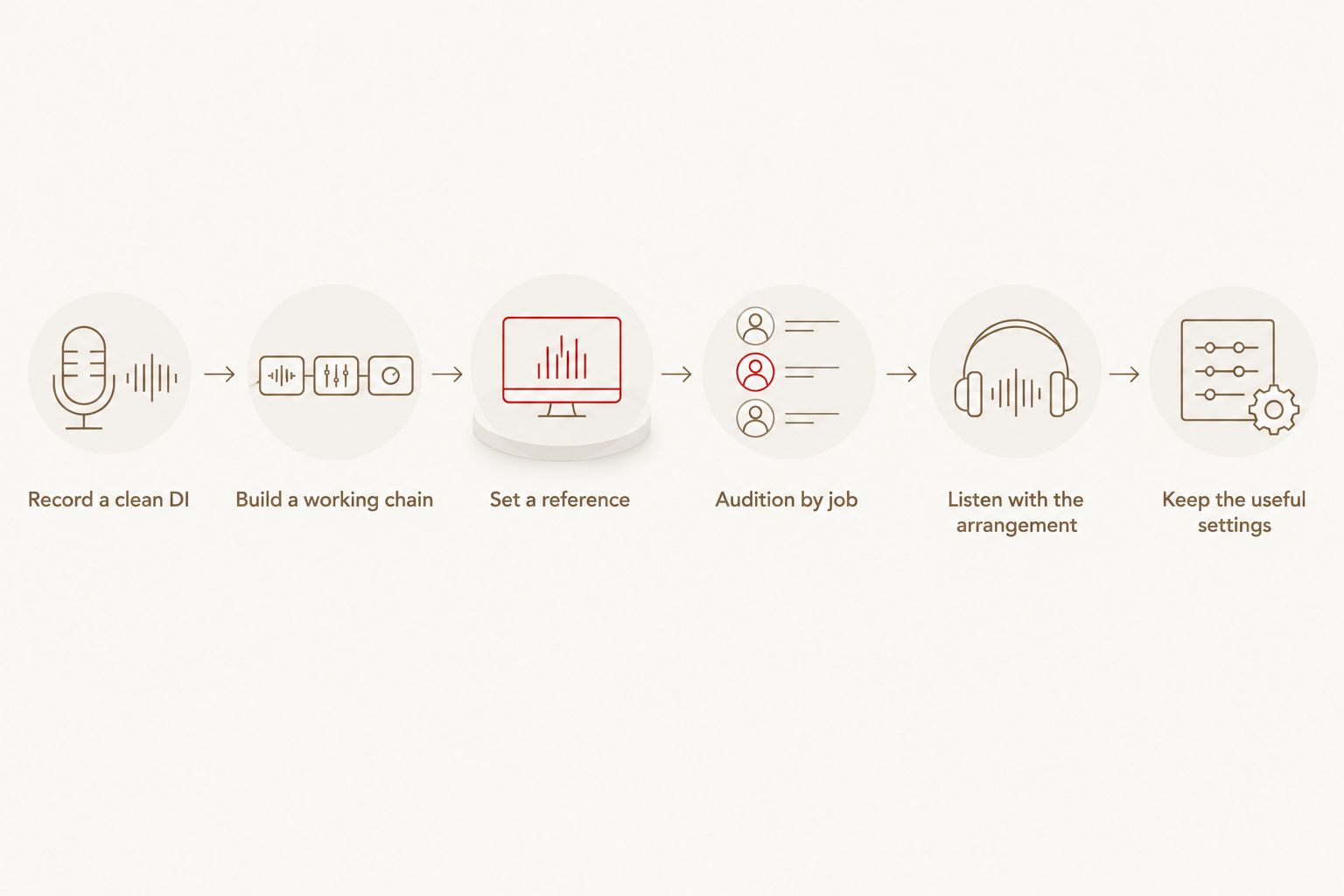
- Record a clean DI. Capture the guitar part you intend to use in the song. Leave enough headroom to avoid clipping the recorded input.
- Build a working chain. Route the DI through your chosen NAM loader. Add a cab or IR stage when the selected capture and chain call for one, then monitor in the mix.
- Set a reference. Keep a tone you already use on a separate track or saved setting. Match listening levels before making a judgement.
- Audition by job. Try a rhythm riff, a chord section or a sustained passage that represents the actual production brief. Do not evaluate every capture with an unrelated lick.
- Listen with the arrangement. Bring in drums and bass. Check pick attack, chord separation and whether the guitar masks the part you need to hear.
- Keep the useful settings. Save the profile choice and the surrounding chain in the session. A file name alone will not preserve the full sound you approved.
For a high-gain rhythm example, the chain is guitar DI, then any pedal capture you choose, then the amp capture, then cab treatment if required, followed by your usual mix processing. This is a routing example, not a requirement to use every component. If a capture already includes the sound of a cab, adding another cab stage changes the result; check the capture details rather than assuming.
Repeat the test at the same listening level before committing. In 2026, an organised audition is more useful than scrolling through captures until the newest one feels exciting. The winner is the setting that survives the full arrangement.


Are NAM profile packs worth it if you already have an amp sim?
Yes, when the pack gives you a captured sound your current amp sim does not deliver efficiently. Keep the amp sim for parts where you need its controls; audition NAM captures for parts where a particular recorded response gets you closer to the target. Owning both formats does not mean every track needs both in its chain.
The fairest comparison uses the same DI performance and a matched listening level. If the amp sim already sits well against the drums and bass, there is no production reason to replace it merely because a new pack exists. In 2026, the right tool is the one that finishes the guitar part without creating another routing problem.
Are NAM packs worth it for beginners?
Yes, if you can load a profile, record a clean DI and identify the style of tone you need. Start with a pack whose stated genre matches a song you are working on, then compare a small selection in context. Do not treat a profile name as a substitute for checking the signal path and cab treatment.
A beginner does not need to understand every piece of captured hardware before making a useful decision. You do need to hear the difference between a gain or cab mismatch and a part that simply needs a better performance. Save the setting that works, so you can return to it when you revise the track.
Should you buy a bigger pack or a genre-focused pack?
Buy a genre-focused pack when you have one clear production brief; choose a broader pack when you need to compare several signal-chain options. VIC AUDIO METAL 2 NAM lists 20 DI amp captures, 10 pedal captures and 22 cab IRs, so its appeal is the range of listed components. ALL THE SMALL TONES has a stated pop-punk and emo focus; SUNEATER has a doom, sludge and stoner focus.
Neither approach guarantees a finished sound. A larger pack costs you more audition time, while a focused pack gives you less room to move outside its stated brief. Decide which limitation matters in your current session before you add anything to the library.
FAQ
Are NAM profile packs worth it for recording metal guitar?
Yes, when the captures fit the metal part and pass a comparison against your current tone in the mix. Check the DI, cab treatment and listening level before blaming the profile.
Do I need a cab IR with a NAM profile?
It depends on the capture and your signal chain. Check whether cab treatment is already part of the sound before adding an IR.
Can a NAM pack replace an amp sim plugin?
A NAM pack can supply captured sounds for a track, but it does not necessarily replace an amp sim's adjustable controls. Compare both with the same DI and keep the one that serves the part.
Is a high-gain NAM pack right for pop-punk guitar?
Choose by the gain and response the song needs, not by a high-gain label alone. ALL THE SMALL TONES is described around mid- and low-gain pop-punk and emo tones.
How do I compare two NAM profiles fairly?
Use the same clean DI and match listening levels before switching profiles. Judge pick attack and chord separation with drums and bass playing.
What does VIC AUDIO METAL 2 NAM include?
The listing states 20 DI amp captures from 10 amps, 10 pedal captures and 22 cab IRs. Check which components your chosen signal chain needs before loading them.
Should I buy another NAM pack if my guitar sounds harsh?
Check the DI level, capture choice and cab treatment first. A new pack will not identify which stage is causing the harsh sound.
One last thing
Before buying a NAM profile pack in 2026, write down the guitar part you need to finish and the single thing your current tone gets wrong. If you cannot name that gap, record the part first. A new capture is valuable when it solves an audible problem, not when it simply gives you more files to browse.