

Is buying MIDI drum grooves faster than programming your own?
Buying MIDI drum grooves is faster than programming from scratch when the groove already matches your riff, feel and drum mapping. You skip writing the initial pattern, but still need to check articulations, edit accents and fit the drums to your arrangement. Start with a groove for a usable foundation; program from scratch when finding and fixing a groove takes more work than writing the part.
- Is buying MIDI drum grooves faster than programming your own? Yes, when the starting pattern fits your riff.
- Oracle Sound MIDI drum tracks suit metal, hardcore and punk producers who want genre-specific starting material.
- Groove libraries remove initial note entry, not mapping checks, arrangement edits or drum-sound decisions.
- Program distinctive kick patterns yourself rather than forcing an unrelated groove around the guitar.
Is buying MIDI drum grooves faster than programming your own?
The speed advantage comes from reusing suitable musical material, not from buying a file. A groove that already supports your guitar part removes the blank-piano-roll stage. An unsuitable groove adds browsing, remapping and editing before you reach the same result.
| Approach | Best for | What you skip | What still needs work | Main drawback |
|---|---|---|---|---|
| Bought MIDI grooves | Genre-based songwriting and draft arrangements | Entering the starting drum pattern | Mapping, accents, transitions and kit sound | Searching becomes wasted work when the groove does not fit |
| Programming from scratch | Exact riff-locking and unusual rhythmic ideas | Searching through existing patterns | Every note, articulation and velocity decision | You build the foundation yourself |
| Editing a bought groove | A useful backbeat with riff-specific kick changes | Rebuilding the entire part | The notes that define your song | Heavy editing removes the original time advantage |
For a beatdown writing session, the BEATDOWN/HARDCORE 10 SONG DRUM MIDI PACK is a genre-specific starting point. Its 10-song format gives you drum material to work from; it does not establish a measured time saving or guarantee a match for your riff.
Why this matters
A drum part has to support the guitar, not just fill the grid. In metal, hardcore and punk, the useful decisions include where the kick reinforces a palm-muted accent, whether the snare establishes a half-time feel, and where the cymbals mark a section change.
Your 2026 writing workflow should separate getting a playable arrangement from finishing the performance. Bought grooves address the first task. They do not remove the second.
Oracle Sound MIDI drum tracks are best for metal, hardcore and punk producers who want genre-specific starting material. The limitation is straightforward: you still have to turn that starting material into your song.
How do you turn a bought groove into a usable drum part?
Use this sequence before changing the drum sound. It keeps you from polishing a pattern that does not support the arrangement.
Establish the riff
Record a clear guitar guide and set the project tempo. Identify the accents that actually need kick reinforcement, rather than treating every picked note as a kick-drum instruction.
Listen for the intended pulse. A halftime breakdown and a driving punk section need different snare placement even when the guitar repeats the same figure. Decide what the drums should make the listener feel before opening the groove browser.
Check the mapping
Use an instrument track hosting your drum instrument, with the MIDI region feeding that instrument. MIDI supplies performance instructions; the drum instrument supplies the sounds.
Audition the imported notes individually. Confirm that kicks trigger kicks, snares trigger the intended snare articulations, and cymbal notes trigger the right cymbals. A convincing rhythm played through incorrect articulations is not a usable starting point.
Save a copy before remapping. If your drum instrument provides a matching map, select it; otherwise, move the affected notes to the required destinations. Check the pack's stated mapping rather than assuming every file uses the same layout.
Audition in context
Play the groove against the guitar guide, not just through the soloed drum instrument. Listen to the kick pattern first, then the snare pulse, then cymbal density.
Reject a pattern if its central feel fights the riff. A groove with an appropriate backbeat and a few unwanted kick notes is an editing candidate. A groove whose entire rhythmic structure needs replacing is not saving you the initial composition work.
Edit the accents
Keep the parts that work. Move, add or remove kick notes around the guitar accents, then check whether the snare should reinforce an impact or leave space for it.
Inspect velocity separately from timing. Accent the hits that carry the phrase and reduce supporting hits where appropriate. Avoid flattening every note to the same velocity unless that uniform response is the sound you deliberately want.
For tight riff-locking, inspect note positions against the guitar transients. Do not apply global random timing just because the part feels mechanical; first check whether repeated velocities, excessive cymbals or identical fills are causing the problem.
Build the transitions
Duplicate the useful section and edit its ending to suit the next riff. Check the last kick, the final cymbal and the first hit of the following section together.
A fill should lead into the next part without covering its defining accent. Remove an imported fill when silence or a simple pickup serves the transition better. Then listen across the edit boundary rather than judging the fill in isolation.
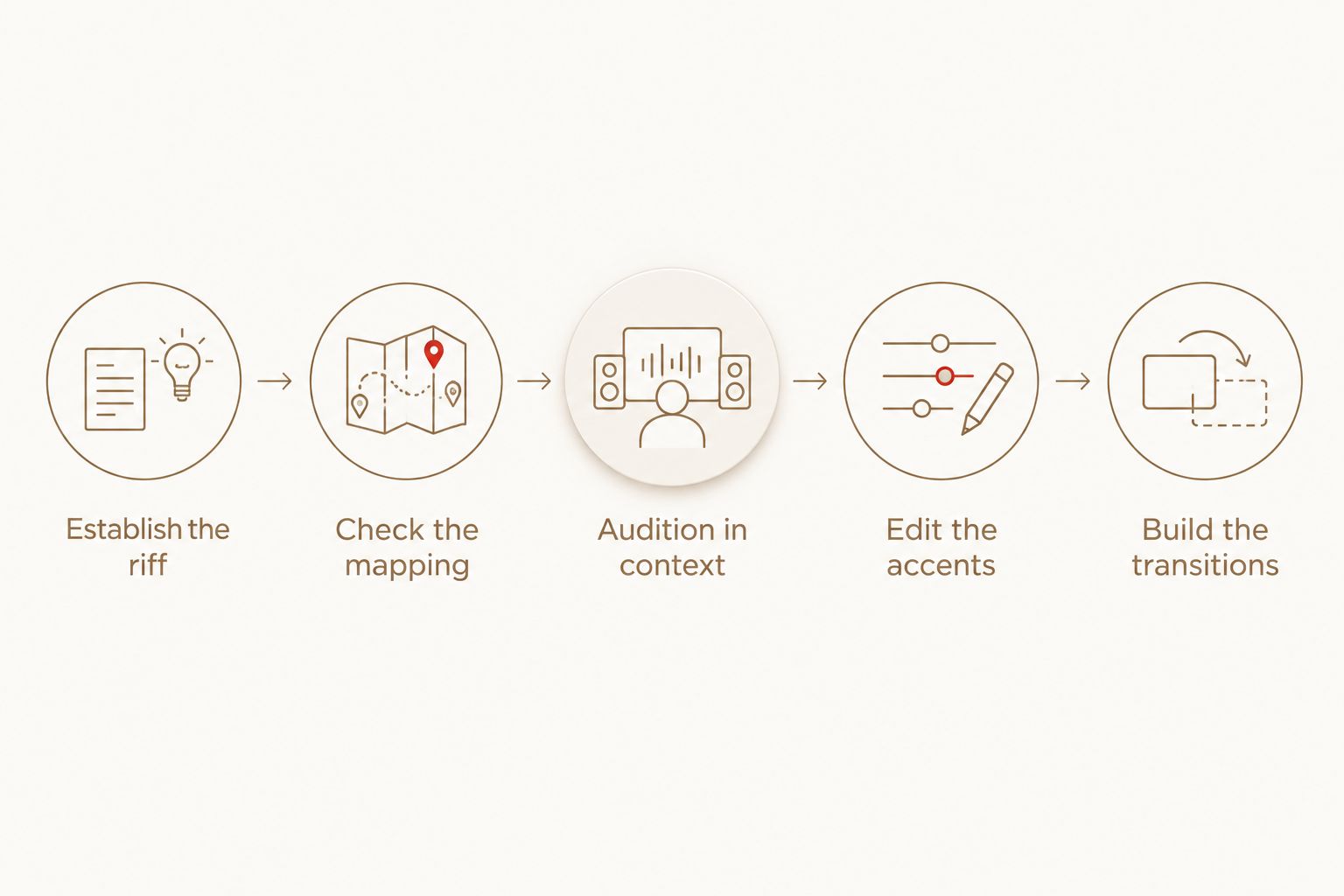
This sequence works for a bought pattern or an existing pattern from your own sessions. In a 2026 DAW project, keep the unedited source region separate from the working arrangement so you can compare changes without reconstructing the original.
When is programming from scratch the better choice?
Program from scratch when the defining rhythm is already clear and no suitable starting pattern is in front of you. Searching is not productive simply because a library contains more material.
For a stop-start metal riff, enter the essential kick accents first. Add the snare pulse, then choose a cymbal pattern that communicates the section's energy. That order makes the guitar-and-drum relationship explicit before you add decoration.
For punk, establish the kick-and-snare drive before writing fills. Check how the hats or ride support the backbeat, and leave room for the vocal phrasing. A technically busy part is not automatically a better arrangement.
Scratch programming also makes sense when you want a deliberate rhythmic departure from the genre's familiar patterns. You control the structure immediately, but you also carry the full workload: note entry, articulation selection, velocity shaping and transitions.
The practical middle ground is to borrow only what fits. Keep a useful cymbal-and-snare pattern, rewrite the kick lane, and replace the ending. Editing a groove is a production method, not a requirement to preserve its original arrangement.
Why the speed advantage varies
The same library can be useful in one session and distracting in another. These factors determine how much initial programming it actually removes:
- Genre fit: A groove built around the right feel gives you relevant starting material. A different backbeat or cymbal approach requires more rewriting.
- Riff fit: A compatible kick pattern needs targeted edits. A conflicting pattern requires rebuilding the song's main rhythmic relationship.
- Drum mapping: Correct note destinations let you assess the musical part immediately. Incorrect destinations require a mapping pass first.
- Arrangement fit: A useful section still needs the right length, ending and transition for your track. A song-based file is not automatically your song structure.
- Editing confidence: If you already know the pattern you want, entering it directly avoids browsing. If you need a starting idea, existing MIDI gives you something concrete to audition.
- Sound selection: MIDI does not determine the finished kit sound. Sample choice, articulation response and mix processing remain separate decisions.
For your 2026 sessions, judge speed at the point where the drums support the guitar arrangement. Importing a file is only the start. A fast import followed by extensive repairs is not a fast route to a usable part.
Which starting material fits your production problem?
Choose by the section you need to write, not by the largest advertised collection. Oracle Sound offers song-based MIDI drum packs and breakdown-focused material; those formats serve different starting points.
| Product | Supplied scope | Best for | Practical advantage | Limitation |
|---|---|---|---|---|
| BEATDOWN/HARDCORE 10 SONG DRUM MIDI PACK | 10 songs | Beatdown and hardcore writing | Genre-specific drum material to build around | Your riff still needs its own accent and transition edits |
| PUNK / MELODIC HARDCORE 13 SONG DRUM MIDI PACK | 13 songs | Punk and melodic hardcore writing | Starting material focused on those styles | Song count does not tell you whether a particular pattern fits |
| MOSH DRUMS 100+ BREAKDOWNS DRUM MIDI PACK | Over 100 breakdowns | Breakdown-focused writing | Material centred on the section you need | Breakdown material does not replace the rest of your arrangement |
The 10-song beatdown pack and 13-song punk pack suit different genre briefs. Neither count is a measure of programming speed. The breakdown pack provides over 100 breakdowns, but you still need to select and adapt the right material.
For a 2026 library shortlist, check the stated content and mapping before buying. Choose the pack that addresses your immediate writing problem, then assess the actual MIDI against your guitar guide.


Should I change the groove before choosing the drum sound?
Fix mapping first, then judge the groove through a usable kit sound. You need to hear the intended articulations to assess the part, but detailed mixing can wait until the rhythm works.
Use a signal chain of MIDI region, drum instrument and drum bus processing. Keep guitar amp sims and pedal plugins on the guitar path. This separates performance edits from tone decisions and makes troubleshooting more direct.
Does a bought groove make the drums sound finished?
A bought groove supplies performance data, not a finished drum mix. You still choose the drum instrument, check its response to velocities and balance the kit against the guitars.
Listen with the bass and vocals once those parts exist. Kick reinforcement that works against a soloed guitar can crowd the full arrangement. Remove unnecessary hits before reaching for more processing.
How do I know whether editing is still saving time?
Editing saves work while you retain useful parts of the original pattern. Compare the remaining changes with the part you would enter from scratch.
If you are replacing the kick, snare, cymbals and fills, stop treating the file as a shortcut. Start a clean region and write the intended rhythm. Keep the abandoned groove only if it offers an idea worth revisiting.
FAQ
Is buying MIDI drum grooves faster than programming your own?
Buying MIDI drum grooves is faster when a suitable pattern removes initial note entry without requiring extensive repairs. Mapping, riff accents and arrangement transitions still need checking.
What's the best approach for a tightly locked metal riff?
Program the defining kick accents yourself, or edit a groove whose backbeat already fits. Choose the approach that requires less rewriting of the essential rhythm.
Can I change the kick pattern in a bought MIDI groove?
Yes, MIDI note data is editable in a suitable DAW or MIDI editor. Keep the useful snare and cymbal parts while adapting the kick notes to your riff.
Do MIDI drum grooves include the drum sounds?
MIDI drum grooves contain performance instructions rather than recorded drum audio. You need a drum instrument or another suitable sound source to hear them.
Will every MIDI drum pack trigger my kit correctly?
Correct triggering depends on the file's note mapping and your drum instrument's mapping. Check the stated formats and audition the articulations before judging the groove.
Which Oracle Sound MIDI drum pack should I start with?
Start with the pack that matches your writing brief: beatdown, punk and melodic hardcore, or breakdown-focused material. Genre fit is a better selection criterion than song count alone.
Should I humanise every imported drum groove?
No, inspect the existing timing and velocities before applying humanisation. Preserve intentional accents and tight riff-locking instead of randomising the entire performance.
One last thing
Save the edited drum part as reusable material, not just as part of the finished song. Your own adapted patterns already contain decisions about the backbeat, articulations and accents that suited your production.
In 2026, make your next writing session start with labelled MIDI: genre, feel and section purpose. Keep the source file separate and record which drum map the working version uses. That turns a useful purchase into a repeatable workflow without pretending the original groove finishes the song for you.