

Are MIDI drum packs worth it for solo producers? Yes, 2026
Yes, MIDI drum packs are worth it for solo producers in 2026 when programming drums keeps interrupting songwriting. You get editable drum parts to build around, but you still need a drum instrument, correct note mapping and arrangement edits; skip another pack if your existing grooves already cover the music you write.
- Are MIDI drum packs worth it for solo producers? Yes, when reusable drum parts solve a songwriting bottleneck.
- Oracle Sound MIDI drum packs suit metal, hardcore and punk producers who want genre-specific starting points.
- MIDI drum tracks contain performance data, not drum sounds; your drum instrument supplies the kit.
- Choose groove libraries by genre, mapping and arrangement needs, not file count alone.
Why this matters
When you write alone, every drum edit competes with recording guitars, arranging vocals and finishing the track. A suitable groove lets you test a riff against an actual drum part rather than a click. That is the useful shortcut—not pretending the imported performance is finished.
Keep the composition decisions; outsource the blank piano roll. A MIDI pack earns its place when you can adapt its kick pattern, accents and transitions without rebuilding everything. For genre-specific selection, start with the MIDI drum packs for punk and hardcore bands guide.
Is a MIDI drum pack worth it for solo producers in 2026?
Yes, if you need a starting performance more than you need a different drum sound. MIDI stores note events, timing and velocity; your drum instrument turns those events into audio. You can change the kit without discarding the rhythm, or change the rhythm without replacing the kit.
| Starting point | Best for | Main advantage | Main limitation |
|---|---|---|---|
| MIDI drum pack | Producers adapting existing performances | Editable hits, accents and arrangements | Requires a drum instrument and mapping checks |
| Programming from scratch | Producers with a specific rhythmic idea | Direct control over every event | You build the performance yourself |
| Audio drum loop | Producers who want the recorded sound and performance together | The sound arrives with the loop | Individual drum hits are less directly editable than MIDI notes |
Oracle Sound MIDI drum packs are best for solo metal, hardcore and punk producers who want genre-specific starting parts. Their value is the material you can adapt, not a guarantee that an imported file will match your riff or produce record-ready drums without work.
Choose a pack when you repeatedly stop writing to construct basic beats. Keep programming from scratch when the exact kick placement, unusual metre or tightly scripted fill is already clear in your head. Combining imported grooves with original edits is also a valid workflow.
Choose the pack around the song you are writing
Oracle Sound offers song-based drum MIDI packs across metal, hardcore and punk. The product titles below identify their genre focus and song counts; those counts describe the pack, not how many finished songs you will produce.
| Pack | Stated scope | Best for | Selection limit |
|---|---|---|---|
| MODERN METAL/HARDCORE 10 SONG DRUM MIDI PACK | 10 songs; modern metal and hardcore | Writing in the modern metal/hardcore lane | Its genre label does not establish a match for your particular riff |
| PUNK / MELODIC HARDCORE 13 SONG DRUM MIDI PACK | 13 songs; punk and melodic hardcore | Punk and melodic hardcore arrangements | Its focus is not a reason to choose it for an unrelated genre |
| GRINDCORE / HARDCORE 38 SONG DRUM MIDI PACK | 38 songs; grindcore and hardcore | Writing within grindcore and hardcore | A larger song count does not establish a better arrangement fit |
Modern metal/hardcore: 10 songs
Choose the MODERN METAL/HARDCORE 10 SONG DRUM MIDI PACK when that genre focus matches your session. Its practical role is to give you drum material to audition underneath heavy rhythm guitars, then edit around the riff.
Listen to where the kick reinforces the guitar and where it adds movement between guitar accents. Do not force every kick to follow every picked note. Recommendation: choose it for modern metal/hardcore writing, not simply because you want more MIDI files.
Punk/melodic hardcore: 13 songs
Choose the PUNK / MELODIC HARDCORE 13 SONG DRUM MIDI PACK when you are writing punk or melodic hardcore. Its stated 13-song scope gives you song-based material within that genre lane.
Audition the drum part against the vocal rhythm as well as the guitars. A busy part that works under an instrumental section can crowd a sung phrase. Recommendation: choose it for punk and melodic hardcore arrangements, then edit the cymbal activity and fills around the song.
Grindcore/hardcore: 38 songs
Choose the GRINDCORE / HARDCORE 38 SONG DRUM MIDI PACK when grindcore or hardcore is your actual writing target. The stated 38-song scope is larger than the other packs listed here, but size alone is not the decision.
Check whether the rhythmic density leaves room for your riff and whether the transitions fit your arrangement. Do not retain a fill just because it arrived with the file. Recommendation: choose it for its genre focus; treat the song count as scope, not a quality score.
For your 2026 sessions, pick the pack closest to the music on the timeline. These are the relevant song-based options from the comparison above.


Why a MIDI drum pack's value varies
The same library can be useful in one session and irrelevant in another. Judge these factors before adding more material:
- Genre fit: the pack's stated style should match the music you actually produce. More unrelated patterns create more auditioning, not a better starting point.
- Your bottleneck: MIDI helps with finding and editing performances. It does not fix a drum instrument whose sounds you dislike.
- Note mapping: the MIDI notes must trigger the intended kit pieces. Fix misplaced kicks, snares, cymbals and articulations before judging the groove.
- Arrangement needs: song-based material and individual grooves serve different tasks. Choose according to whether you need structural ideas or a specific section.
- Editing requirements: an imported performance still needs to follow your accents, stops and transitions. A close musical fit matters more than a high file count.
Turn imported MIDI into a usable drum track
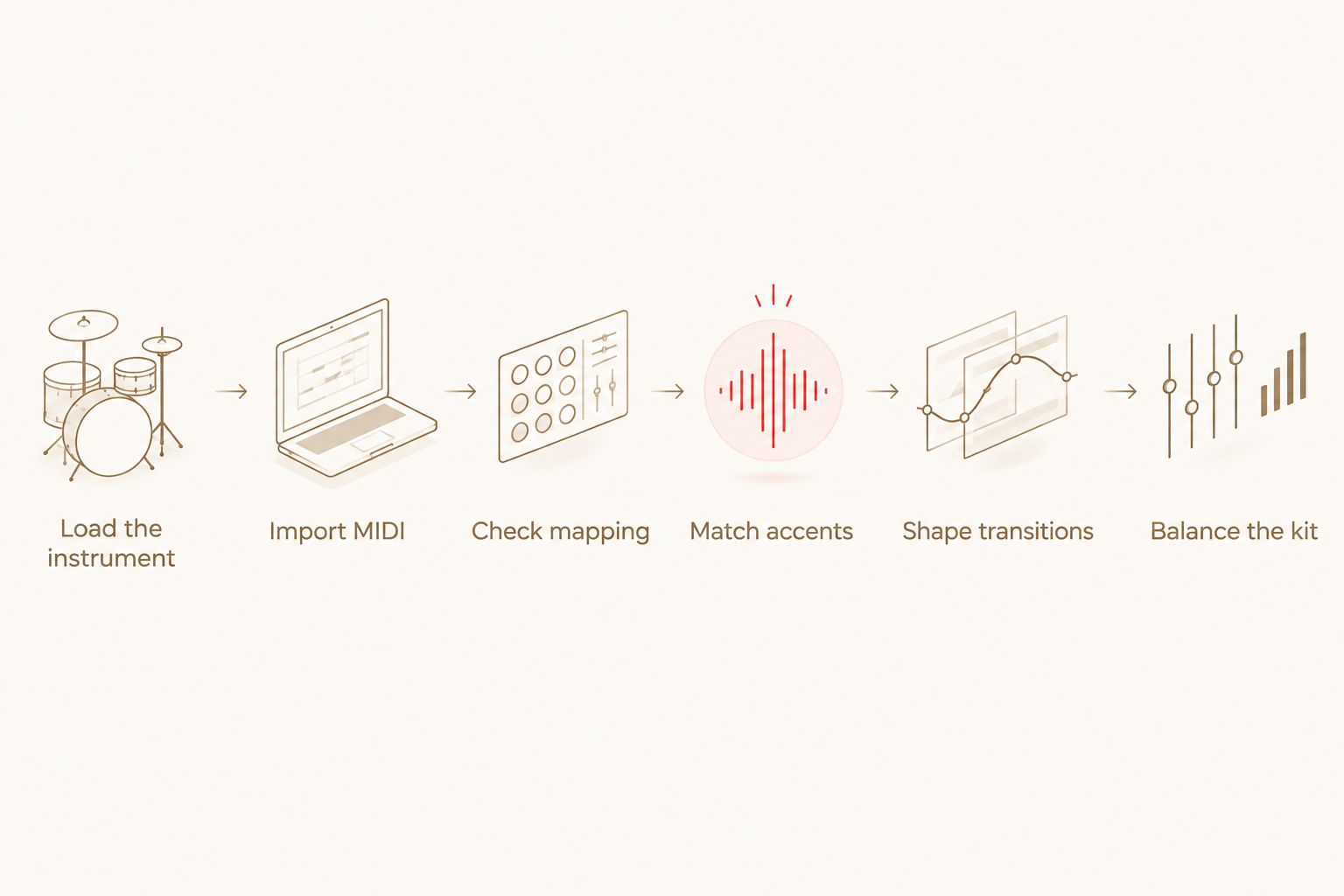
Use this sequence in your DAW before committing to a groove. Keep the guitar reference audible throughout; a convincing drum solo is not the test.
- Load the instrument. Put your drum instrument on an instrument track and confirm that incoming MIDI triggers it. Leave additional processing bypassed while checking the performance.
- Import MIDI. Place the file at the intended section boundary. Check the project tempo, clip length and any imported tempo information before auditioning it against the riff.
- Check mapping. Audition the kick, snare, hats, toms and cymbals individually. Correct notes that trigger the wrong kit pieces or articulations.
- Match accents. Edit kick placements around the guitar's key accents and rests. Keep rhythmic movement that supports the riff rather than matching every guitar attack automatically.
- Shape transitions. Trim fills that cross section boundaries and remove cymbal hits that fight intentional stops. Make the next section arrive where the song needs it.
- Balance the kit. Adjust velocities and instrument levels in the full mix. Save an untouched copy of the imported MIDI before making further changes.
This order separates technical faults from musical choices. If a cymbal note triggers a tom, the problem is mapping—not a bad groove or the wrong drum tone.
A practical metal and hardcore signal chain
Use MIDI clip, drum instrument, drum outputs, drum bus as the basic chain. Keep guitar tracks separate, then listen to guitars and drums together while making arrangement decisions.
Start with a dry enough kit presentation to hear the attacks clearly. If the kick obscures the guitar rhythm, check its pattern and level before adding processing. A crowded arrangement does not become clearer just because you compress it.
For a breakdown, align the intended stops across kick, cymbals and guitars. For a faster section, listen for fills that interrupt momentum. Change the part first; shape the sound after the rhythm works.
Settings to check before you humanise anything
Leave additional random timing and velocity processing off while you inspect the imported performance. It already contains timing and velocity information, and random changes are not a substitute for deliberate accents.
If you need to repair straight subdivisions, use a 1/16-note grid as an editing reference—not a command to move every hit. Preserve intentional swing or other subdivisions. Raise the hits you want accented and reduce supporting hits according to the musical phrase and the drum instrument's response.
Edit with intent rather than applying blanket humanisation. A repeatable accent pattern and a fill that resolves correctly do more for the arrangement than arbitrary variation.
Do MIDI drum packs include drum sounds?
No. A MIDI drum pack supplies performance data, while a drum instrument supplies the audible kit. Importing the MIDI onto a track without a suitable instrument does not create a finished drum recording.
That distinction also explains why changing kits can change your judgement of a groove. Audition the performance through the kit you intend to use, with the note mapping corrected.
Should I programme drums myself instead?
Programme drums yourself when you already know the part or need precise control over unusual rhythms. Start from a pack when finding a usable performance is the task holding you up.
You do not have to choose one method permanently. Keep an imported snare-and-hat pattern, rewrite the kick around your riff and build your own transition. The finished arrangement is the priority.
How do I decide whether another pack is worth it?
In 2026, choose another pack only when it fills a specific gap in your current drum material. Name that gap before browsing: a genre, a section type or an arrangement starting point.
Also check the current licence terms before commercial use. A pack's name and song count do not establish its licensing permissions, instrument requirements or supported mappings.
FAQ
Are MIDI drum packs worth it for solo producers in 2026?
Yes, MIDI drum packs are worth it for solo producers when finding drum performances interrupts songwriting. They provide editable starting parts, but you still need a drum instrument and arrangement edits.
Can I use a MIDI drum pack without a drum plugin?
You need a sound source that responds to the MIDI, such as a DAW drum instrument or another compatible drum instrument. The MIDI file itself does not contain recorded drum sounds.
Will a drum MIDI pack work with any drum instrument?
Correct note mapping is required for the MIDI to trigger the intended drums and articulations. Check the pack's supported mappings and your instrument's note assignments rather than assuming they match.
Can I change the kick pattern in an imported groove?
Yes, you can edit MIDI kick notes independently of the other drum events. Check that your edits reinforce the guitar accents without removing useful rhythmic movement.
Are more songs in a MIDI pack always better?
No, song count describes scope rather than musical fit. Choose material that matches your genre and arrangement needs instead of selecting the largest number.
Are Oracle Sound MIDI drum packs suitable for heavy music?
Oracle Sound offers MIDI drum packs explicitly focused on metal, hardcore and punk. Choose the stated genre closest to your session, then check mapping and edit the performance around your song.
Do MIDI drum packs make every song sound the same?
A MIDI pack does not lock your arrangement: you can change notes, timing, velocities and kit sounds. Reusing an unchanged groove also reuses its rhythmic pattern, so edit around each song's accents and transitions.
One last thing
Before buying more grooves in 2026, replay an existing drum part through the kit you actually want to record. Then change its kick accents and final fill to match your riff.
That separates a missing performance from a sound-selection problem. If the rhythm works after those edits, you need to finish the song—not expand the library. If the musical starting point is still wrong, choose a pack with a closer genre focus.