

How many NAM profiles does a metal guitarist need?
You need enough NAM profiles to cover the guitar sounds your songs actually use, not a fixed library size. Start with a dependable rhythm tone, then add profiles only when a lead, clean passage or contrasting rhythm part needs a different response; cabinet processing and input level still need attention regardless of how many profiles you own.
- How many NAM profiles do I need? Keep profiles that fill distinct musical roles, not duplicate sounds.
- Oracle Sound NAM profile packs suit metal, hardcore and punk producers choosing guitar tones by genre.
- Judge high-gain profiles against bass and drums before adding more captures to your working library.
- An amp capture, pedal capture and cabinet IR perform different jobs; do not count them as interchangeable tones.
How many NAM profiles does a metal guitarist need?
Your working library is complete when it covers your arrangements without forcing a tone change that the song does not need. A rhythm-only recording does not require a separate lead or clean profile. A track with contrasting sections needs sounds that support those contrasts.
Use this role-based comparison instead of treating every file in a pack as another essential sound:
| Tone role | Best for | Keep it when | Limitation |
|---|---|---|---|
| Main rhythm | Palm-muted riffs and distorted chords | Attack and chord definition work against the rhythm section | A useful rhythm tone does not automatically suit exposed leads |
| Contrasting rhythm | Sections that need a different texture | The change remains audible inside the arrangement | A similar capture adds browsing without a useful contrast |
| Lead | Melodies and sustained phrases | Notes retain definition with the intended effects | Extra saturation can blur fast passages |
| Clean or lower gain | Intros, breaks and dynamic passages | The arrangement actually uses that sound | It adds no practical coverage to a fully distorted song |
If you are still setting up the loader, use the NAM profiles to Neural Amp Modeler setup guide before judging the library. A routing problem is not a shortage of profiles.
For your 2026 session template, save the sounds you have already checked against your own guitar and arrangement. Keep the wider collection available for auditions, but do not make every writing session start with a catalogue search.
Why this matters
A folder full of high-gain captures does not tell you which sound belongs in the track. Your useful library is the subset that survives a mix-context audition. That distinction matters when a solo guitar tone sounds huge but obscures the bass or makes chord changes hard to hear.
Separate tone selection from tone collecting. Choose a profile because it solves an audible problem: indistinct palm mutes, an unsuitable gain character or a lead that disappears behind the rhythm guitars. Do not add another capture merely because its filename names a different amp.
Keep your raw DI recording. It lets you revisit the tone without replacing the performance, which makes profile comparisons more controlled and keeps sound selection separate from playing variations.
Main rhythm: keep the profile that carries the riff
Your main rhythm profile earns its place through articulation. Listen to the pick attack, the space between muted notes and the definition of sustained chords. Check the riff with bass and drums playing, not just with the guitar soloed.
For metalcore and hardcore arrangements, compare the profile on both a stop-start passage and an open-chord section. A sound that flatters isolated chugs still needs to handle the rest of the song. Keep the guitar performance unchanged while you audition.
Do not assume a denser sound needs more distortion. If note boundaries disappear, compare a less saturated capture before adding more processing. Adjust the loader's input according to the capture's documentation rather than treating input gain as an unrestricted tone control.
Best for: your default writing and tracking sound. Its limitation is familiarity: a reliable rhythm profile is a starting point, not a reason to give every song identical guitar treatment.
Contrasting rhythm: add a sound only when the section changes
A contrasting profile needs a musical reason to exist. A verse with a dry, defined attack and a chorus with a more saturated texture presents a clear use case. Two captures that sound effectively alike in the mix do not provide the same benefit.
Test the transition rather than the isolated tones. Play the end of the verse into the chorus and listen for the intended change in weight, clarity or texture. Match playback loudness so a level jump does not masquerade as a better sound.
For doom and sludge, the contrast might involve saturation and sustain rather than a sharper pick attack. For punk, a lower-gain sound can preserve chord definition without changing the arrangement. Choose the response that serves the passage.
Best for: arrangements with intentional tonal contrasts. The drawback is extra session management, so leave this role empty when your main rhythm sound already does the job.
Lead and clean tones: let the arrangement decide
Lead parts need evaluation with their effects engaged. Delay and reverb change how a sustained phrase sits behind or above the rhythm guitars. Audition the profile with that context intact rather than choosing a dry lead sound and assuming the effects will fix it.
A rhythm profile can also handle leads if the notes speak clearly. Save a separate lead preset for its processing without automatically adding another NAM capture. A different preset and a different profile are not the same requirement.
Clean and lower-gain sounds deserve space when your song uses them. Check their transition from distorted sections, including perceived loudness and effect tails. Do not force a clean profile into a library built for a project that never needs clean guitar.
Best for: arrangements with exposed melodies or dynamic breaks. The limitation is unnecessary complexity when those roles are absent.
Build a working NAM chain before expanding the library
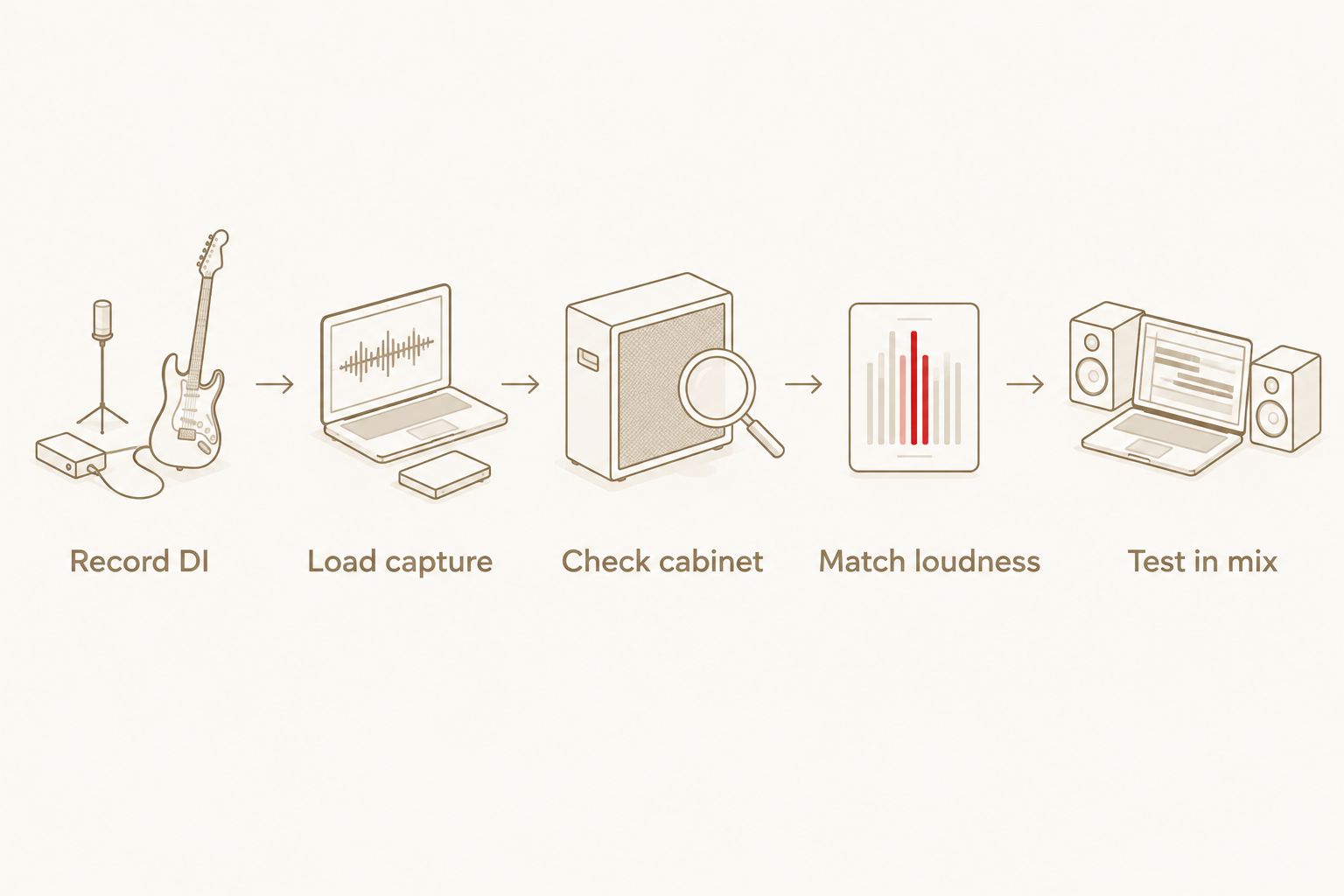
Use this sequence for a direct amp capture that needs separate cabinet processing:
Recorded DI, optional pedal stage, NAM amp capture, cabinet IR, then post effects.
Check the capture documentation first. A capture that already includes a cabinet or microphone chain does not need the same treatment as a direct amp capture. Adding cabinet filtering again changes the result and can make a useful profile sound unsuitable.
- Record DI. Use a clean instrument input and avoid clipping. Save the unprocessed performance so each audition starts from the same playing.
- Load capture. Select a profile suited to the role and follow its input-level guidance. Leave optional pedal processing bypassed until you have heard the amp response.
- Check cabinet. Establish whether cabinet processing is included. Add an IR when the direct amp capture requires it, then keep that IR fixed while comparing amp profiles.
- Match loudness. Adjust output level after the tone-producing stages. Do not change input gain simply to make an audition louder.
- Test in mix. Bring back bass, drums and the other guitar parts. Save the chain only if it improves the intended passage.
This is a repeatable audition process for a 2026 recording session, not a prescribed set of gain or EQ values. Your instrument, capture and arrangement determine the settings.
Changing the profile, cabinet and pedal stage together makes diagnosis harder. If the result improves, you cannot tell which change mattered. Establish a reference chain, change a component, then listen again.
Why the number of useful NAM profiles varies
The number follows your production requirements rather than a universal metal-guitar target. Use these factors to decide whether another profile fills a real gap:
- Arrangement: distorted-only songs need different coverage from songs with clean breaks and exposed leads.
- Genre: tight high-gain rhythm, lower-gain punk chords and sustained sludge riffs ask different things of a guitar sound.
- Instrument and playing: pickups, tuning, picking strength and muting affect what reaches the model.
- Capture chain: direct amp captures and captures with cabinet processing need different downstream treatment.
- Production role: writing your own material is different from preparing a reusable library for varied recording sessions.
An additional profile should address one of those requirements. If you cannot name the passage or response it improves, leave it outside the active shortlist.
What does a NAM pack's file count actually tell you?
A pack's file count describes its contents, not how many sounds you must use. Amp captures, pedal captures and cabinet IRs are different components. Versions or formats also need to be distinguished from distinct musical roles.
Oracle Sound's supplied catalogue description for VIC AUDIO METAL 2 NAM lists 20 DI amp captures from 10 high-gain amps, 10 pedal captures and 22 cab IRs, delivered in NAM A1 and A2 formats. Those are pack contents, not a recommended personal-library size. The 22 cab IRs are cabinet-processing choices, not 22 additional NAM amp profiles.
For a 2026 library audit, classify files by function before counting them. Then shortlist complete signal chains that you can actually use in songs. This keeps a large pack from becoming a large default preset menu.
Choose a pack by its production job
Oracle Sound NAM profile packs suit metal, hardcore and punk producers choosing tones by genre. These examples address high-gain recording, but their stated contents support different selection priorities.
| Pack | Best for | Stated scope | Practical limitation |
|---|---|---|---|
| VIC AUDIO METAL 2 NAM | Producers building direct-amp chains with separate pedal and cabinet choices | 20 DI amp captures, 10 pedal captures and 22 cab IRs; NAM A1 and A2 formats | Separate components require routing decisions and a focused shortlist |
| WVRMFOOD HARDCORE HIGH GAIN NAM PROFILES | Hardcore producers seeking a genre-focused high-gain pack | The description names 5153, Soldano SLO, Crab CALI, Crab SATAN, Diezel VH4 and Bogner UBERSCHALL sources | Genre fit does not replace auditioning with your guitar and mix |
Choose VIC AUDIO METAL 2 NAM when the separate amp, pedal and cabinet components match your workflow. Consider WVRMFOOD HARDCORE HIGH GAIN NAM PROFILES when hardcore-focused high-gain material matches the project. Neither choice removes the need to check input level, cabinet treatment and articulation.
Do I need different NAM profiles for double-tracked guitars?
You do not need different profiles simply because you double-track rhythm guitars. Record separate performances and judge whether the same chain gives the arrangement enough width and definition.
Different profiles are an artistic option, not a substitute for separate takes. Try a contrasting chain when you want a deliberate tonal difference, then check the combined guitars for balance and clarity.
Should I buy more profiles if my metal tone sounds muddy?
Check the existing chain before expanding your library. Confirm cabinet routing, compare input level against the capture guidance and listen for excessive saturation or conflicting low-frequency content in the arrangement.
In a 2026 troubleshooting session, keep the DI performance fixed and change the suspected cause first. Add another profile when the current capture's response remains wrong for the part, not before checking the chain around it.
FAQ
How many NAM profiles do I need for metal guitar?
You need profiles that cover the distinct sounds your arrangements use, not a universal file count. Start with a reliable rhythm sound and add contrasting, lead or clean profiles only when those roles require a different response.
Can I use the same NAM profile for rhythm and lead?
Yes, the same NAM profile can serve rhythm and lead if it supports both parts. Save different processing presets when leads need delay, reverb or output-level changes.
Does a NAM amp profile always include a cabinet?
No, cabinet processing depends on what was captured. Check the capture documentation and use separate cabinet processing when the direct amp capture requires it.
Do more NAM profiles automatically give me a better metal tone?
No, a larger collection does not establish whether a profile suits your performance and arrangement. Compare articulation and balance with bass and drums playing.
What comes in VIC AUDIO METAL 2 NAM?
VIC AUDIO METAL 2 NAM lists 20 DI amp captures from 10 high-gain amps, 10 pedal captures and 22 cab IRs. The supplied description also states NAM A1 and A2 formats.
Which Oracle Sound NAM pack should I consider for hardcore?
WVRMFOOD HARDCORE HIGH GAIN NAM PROFILES is a hardcore-focused option in the Oracle Sound catalogue. Choose it by its intended genre and audition the resulting chain against your own guitar parts.
One last thing
Archive complete chains, not just favourite profile filenames. Save the capture reference, cabinet choice, input setting and post-processing with the DAW session. A profile alone does not document the tone you approved.
Before expanding your 2026 library, reopen a finished session and identify which sounds actually made the recording. That shortlist is a more useful starting point than every capture you have downloaded.