

Can You Resell Songs Made With MIDI Drum Grooves? Yes | 2026
Yes—you can sell songs made with MIDI drum grooves when the groove library’s licence permits commercial use in finished music. That permission does not automatically let you resell the original MIDI files, distribute editable grooves to clients, or promise exclusive ownership of the underlying pattern.
- Can you resell songs made with MIDI drum grooves? Yes, when the library licence permits commercial releases.
- Selling a finished song and reselling its source MIDI files are different uses; check each permission separately.
- Oracle Sound supplies MIDI drum tracks and groove libraries; check the relevant licence before commercial delivery.
- Check your drum instrument’s licence too: MIDI triggers the kit, but the rendered recording contains its sounds.
Can you resell songs made with MIDI drum grooves?
Sell the finished music only under permissions that cover your intended release and delivery. Buying a groove library gives you the rights stated in its licence, not an unrestricted right to distribute everything inside it.
Oracle Sound sells MIDI drum tracks and groove libraries alongside guitar amp and pedal plugins. The same release checklist applies whether you are building a hardcore breakdown, a punk single or a metal production for a client.
Start by identifying what you are actually selling. A stereo master, an isolated drum stem and an editable MIDI arrangement give the recipient different material and different opportunities to reuse it.
| Delivery format | Best for | Production advantage | Licensing concern |
|---|---|---|---|
| Finished stereo song | Listeners and release distribution | Delivers the complete recording without editable source grooves | Confirm permission for commercial music releases |
| Full-song drum stems | Mixing engineers | Allows balance and processing changes | Check whether isolated audio delivery is covered |
| Editable DAW session | Production collaborators | Keeps arrangement and instrument choices editable | Can expose licensed source MIDI and other assets |
| MIDI groove bundle | Other producers seeking reusable patterns | Delivers editable performance data | Requires permission to redistribute the MIDI itself |
A file extension does not settle the question. Rendering a groove to audio changes the format; it does not create redistribution rights that the licence never granted.
Why this matters before your 2026 release
A MIDI groove is performance data rather than a recorded drum sound. It tells an instrument which notes to play, when to play them and how strongly to trigger them. Your drum instrument supplies the audible kit.
That creates separate checks: permission to use the groove, permission to use the instrument’s sounds, and permission to deliver the particular files your customer expects. Keep those checks separate instead of treating the entire drum track as a single licensed asset.
The practical problem arrives at handover. You finish a song, then the client asks for the session with every MIDI clip intact. A licence that covers your finished recording does not necessarily cover that extra delivery.
Agree on the deliverables before you start programming. A clear handover list prevents a mixing request from turning into an unauthorised source-library transfer.
Check the licence before you commit the groove
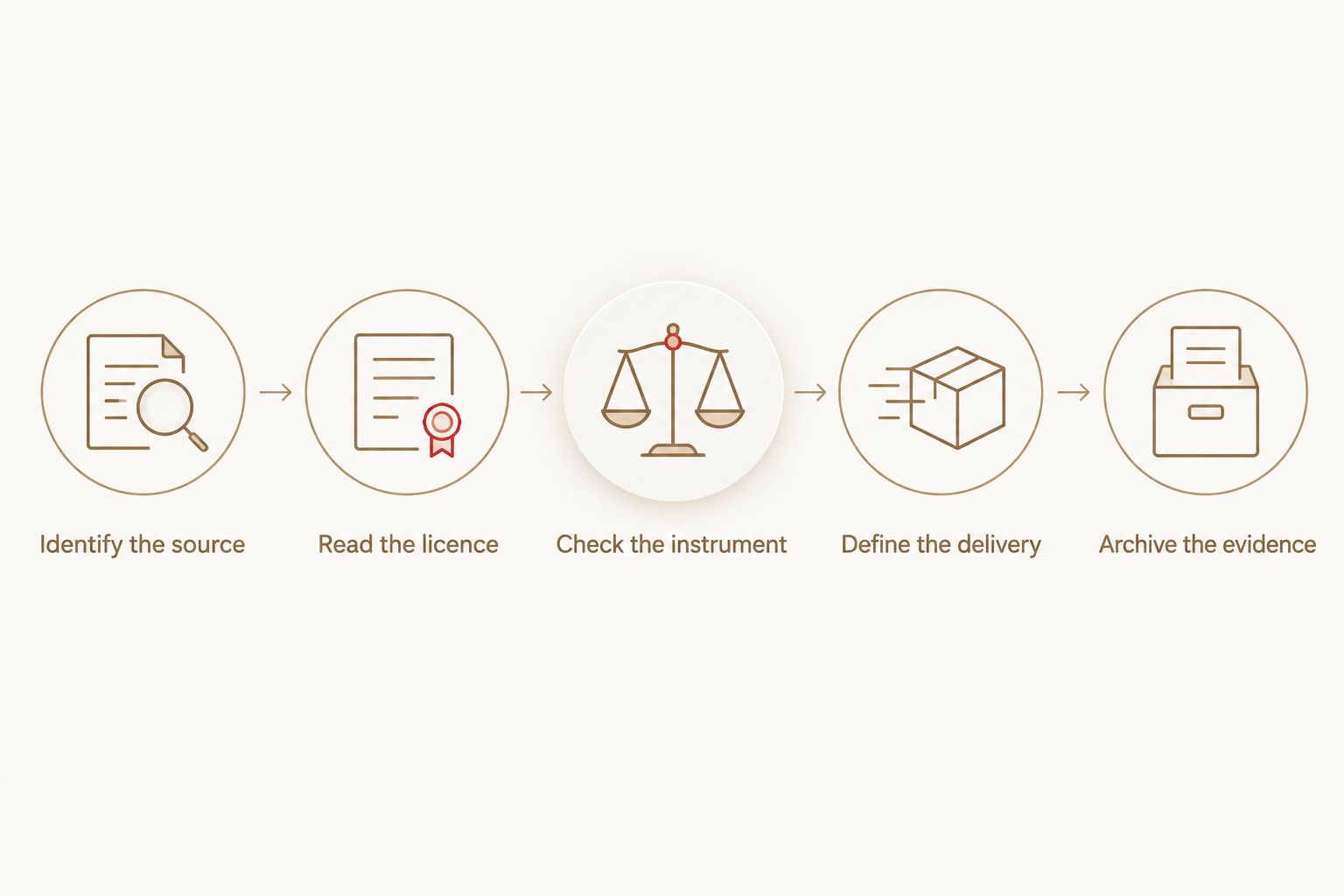
Use this sequence for a commercial release in 2026. Apply it to the actual pack and instrument you use, not another product from the same seller.
- Identify the source. Record the groove pack, supplier and original file names. Keep this information with the session so you can trace the drum arrangement later.
- Read the licence. Find the terms covering commercial recordings, client work and any restrictions on redistribution. Save the applicable text with your purchase record.
- Check the instrument. Confirm that the drum instrument and any imported samples permit your intended audio use. The MIDI pack’s permission cannot grant rights to somebody else’s samples.
- Define the delivery. Write down whether you will supply a stereo master, full-song stems, editable MIDI or a complete DAW session. Check each requested format against the terms.
- Archive the evidence. Keep the licence, purchase record, source list and agreed deliverables together. Resolve unclear permissions before release or client handover.
This is a rights check, not a tone-setting exercise. A crushing drum sound does not make a restricted file reusable, and a receipt alone does not explain every permitted use.
Keep a copy of the terms that applied to your purchase rather than relying on memory. Record the purchase date separately from the release date; a 2026 release date does not tell you which terms applied when you obtained the files.
Why permission varies between deliveries
The important variables concern the material, the rights granted and what leaves your studio—not whether the groove sounds like metal, hardcore or punk.
- Licence scope: Commercial recording permission and redistribution permission address different uses. Read the wording for each.
- Delivered material: A mixed song, an isolated recording and editable performance data are not interchangeable deliverables.
- Recipient access: An editable session can give another producer access to the original groove even when the final master does not.
- Sound source: A drum sampler, expansion library or imported one-shot has its own usage terms.
- Exclusivity promises: Permission to use a shared library does not establish exclusive rights to that library’s content.
These factors explain why a song release can be permitted while a MIDI bundle is restricted. Do not apply an answer about one delivery format to every other format.
Can you sell a song without changing the drum groove?
Editing is not a substitute for permission. If the licence permits your commercial recording, use it within those terms; if it prohibits redistribution, changing velocity or moving hits does not automatically remove that restriction.
Treat arrangement edits as production decisions. You change a groove because the kick needs to follow the guitar, the snare needs more space, or the fill needs to land on the next section—not because a particular edit count makes the source yours.
For a practical example, build a 4-bar arrangement at 120 BPM. Those are chosen practice settings, not release requirements. Place the groove against your riff and check where kick hits support the palm-muted accents.
Then work through the musical details:
- Match kick placement to the riff’s intended accents rather than every guitar attack.
- Remove cymbal hits that crowd a vocal entrance.
- Adjust snare velocity for the contrast you want between main hits and ghost notes.
- Rewrite the transition fill to land cleanly on the next downbeat.
- Audition the pattern with the actual kit before committing the arrangement.
MIDI velocity uses a 0–127 scale. Your drum instrument determines how velocity affects loudness, sample selection or other responses, so do not assume the same value sounds identical across different kits.
For further programming context, see the guide to MIDI drum packs for punk and hardcore bands. Musical fit and licensing clearance remain separate decisions throughout the session.
Can you give the client the MIDI drum track?
Deliver editable MIDI only when the licence permits that handover. A client paying for production does not automatically become an authorised recipient of the source library.
Ask what the client needs to accomplish. If the request is for mixing control, audio stems can provide that control without handing over editable grooves—but you still need to check permission for the stems themselves.
If the client needs to rewrite the performance, ask the supplier whether the proposed transfer is allowed. Where a separate licence is required, confirm that requirement before packaging the session rather than assuming either party’s purchase covers everyone.
Inspect the DAW project before delivery. Unused tracks, hidden clips, backup arrangements and export folders can contain original MIDI files that are not part of the agreed handover.
Do not embed installers, entire sample libraries or purchased groove folders merely to make a project open without errors. Convenience does not expand the rights granted by those assets’ licences.
Can you promise exclusive ownership of the finished song?
Only promise rights you control. A finished recording can contain your original work alongside licensed material, and your contract should distinguish those contributions.
A shared groove library is not evidence that you own its underlying patterns exclusively. Editing the performance, choosing a different kit or adding original guitars does not establish exclusive ownership of the source files.
Discuss what exclusivity means with the buyer. Ownership of your recording contribution, permission to release the master and exclusive control over every source asset are different requests.
For client work in 2026, identify licensed third-party components before signing an exclusivity clause. If the contract requires rights you cannot document, get appropriate legal advice or use material for which you can establish the required rights.
Where MIDI groove libraries fit in a heavy production
Oracle Sound MIDI drum packs suit metal, hardcore and punk producers building drum arrangements around heavy riffs. Their role is to provide performance material for songwriting; the licence determines how that material can leave your session.
The production advantage of a groove library is an editable starting point. The limitation is that neither the groove nor its licence settles your drum sound, mapping, client handover or exclusivity obligations.
Use a straightforward signal chain: MIDI groove, drum instrument, individual drum processing, drum bus. Keep the source MIDI available while you arrange, then decide what to render according to the agreed delivery and applicable permissions.
Before chasing compression settings, check the drum map. A note intended for a kick or snare can trigger a different articulation when the receiving instrument uses another mapping layout.
Check kick, snare, toms, cymbals and articulations against the instrument’s documentation. Then audition a complete section with guitars and bass. A groove that works alone still needs to support the song.
For Oracle Sound MIDI drum tracks, use the same discipline you would apply to any licensed groove library: document the source, verify the terms and deliver only the permitted assets. Product choice is a songwriting decision; rights clearance is a release decision.
FAQ
Can you resell songs made with MIDI drum grooves in 2026?
Yes, when the MIDI library’s licence permits commercial use in finished songs. Check the drum instrument’s terms and your intended delivery format separately.
Can I sell the MIDI grooves themselves?
Only if the licence permits redistribution or resale of the MIDI files. Permission to release a finished recording does not automatically cover selling a reusable groove bundle.
Do I need to change every groove before releasing a song?
Follow the licence’s requirements rather than assuming edits create permission. Changing timing, velocity or orchestration is a production choice, not an automatic way around redistribution restrictions.
Does royalty-free mean I own the drum pattern?
No, royalty-free describes a licensing arrangement, not automatic ownership of the underlying material. Read the terms for permitted uses, attribution requirements and restrictions.
Can I send my client the complete DAW session?
Only when the licences for its included assets permit that delivery. Check editable MIDI, samples and other third-party material before transferring the project.
Can I sell isolated drum stems from a MIDI groove?
Check permission for isolated audio delivery in both the groove and sound-library terms. A full-song stem and a reusable drum-loop product are different proposed uses.
Do Oracle Sound MIDI drum packs automatically allow every commercial use?
Use the applicable product licence to establish permission for your specific use. A product category or purchase record alone does not establish rights to redistribute files or promise exclusivity.
What should I keep with my 2026 release files?
Keep the applicable licences, purchase records, source list and agreed deliverables. Record which groove library and drum instrument contributed to the finished track.
One last thing
Audit the handover folder, not just the final mix. A permitted master can sit beside an original MIDI folder that you never intended to distribute.
Before sending the project, reopen the exact delivery copy and inspect its contents. Remove material outside the agreed scope, confirm that the remaining assets are permitted, and keep your source-and-licence archive separate from the client package.