

Can NAM Profiles Replace a Real Amp? Yes, for Recording | 2026
Yes. In 2026, NAM profiles can replace a real guitar amp for recording a direct guitar signal in a DAW, provided you pair the capture with an appropriate cabinet sound and monitor through a low-latency setup. They do not replace the physical push of a loud speaker cabinet in the room, and a saved capture does not give you every control on the original amp.
- NAM profiles can replace a real amp for recorded guitar tracks, but not its physical in-room response.
- Oracle Sound NAM profiles suit metal and hardcore producers who need repeatable guitar tones in a DAW.
- Check whether a capture needs a separate cab IR before judging the tone.
- Keep the dry DI when recording so you can change profiles without replaying the part.
Why this matters
If you track heavy guitars at home, the useful question is not whether a NAM capture feels identical to standing beside an amp. It is whether the recorded part works against the bass and drums without setting up a loud cabinet and microphone. In 2026, that distinction decides whether a profile can take the amp's place in your recording workflow.
A pack such as VIC AUDIO METAL 2 NAM gives you amp captures, pedal captures and cab IRs to work with. That makes it relevant to a direct-recording decision; it does not mean every capture will suit every guitar, tuning or mix. Judge the processed track in the song, not the guitar sound in isolation.
Can NAM profiles really replace a real guitar amp?
For a finished DAW guitar track, yes; for the sensation of playing through a loud cabinet, no. A NAM amp capture reproduces the behaviour represented in that capture. You still need the rest of the recording chain: a clean input, an appropriate cabinet sound, monitoring you can play through and a mix that leaves space for the guitar.
| Decision | NAM profile in a DAW | Real amp and cabinet |
|---|---|---|
| Best for | Repeatable direct recording and changing tones after a performance | Playing through a physical cabinet and recording that cabinet with a microphone |
| Main advantage | Recall a capture without resetting an amp or microphone | Hear and feel the cabinet in the room while playing |
| Main limitation | A capture represents a captured setup, not every possible amp setting | Changing the recorded sound can require another performance or recording pass |
| What you must check | Input level, capture, cab IR and monitoring | Amp settings, cabinet, microphone placement and recording level |
Neither option fixes a weak performance. If the pick attack and palm mutes are inconsistent, changing from a microphone to a profile will not make the rhythm part tighter. Record a short passage with the drums and bass playing, then compare the guitar's attack and note definition in context.
What does a NAM profile actually replace?
A NAM amp capture replaces the amp stage represented by that capture in your signal chain. It does not automatically replace your guitar, interface, cabinet simulation, monitoring or the choices you make while mixing. Treating it as a complete rig without checking the capture's contents is a common reason a direct guitar track sounds harsh or unfinished.
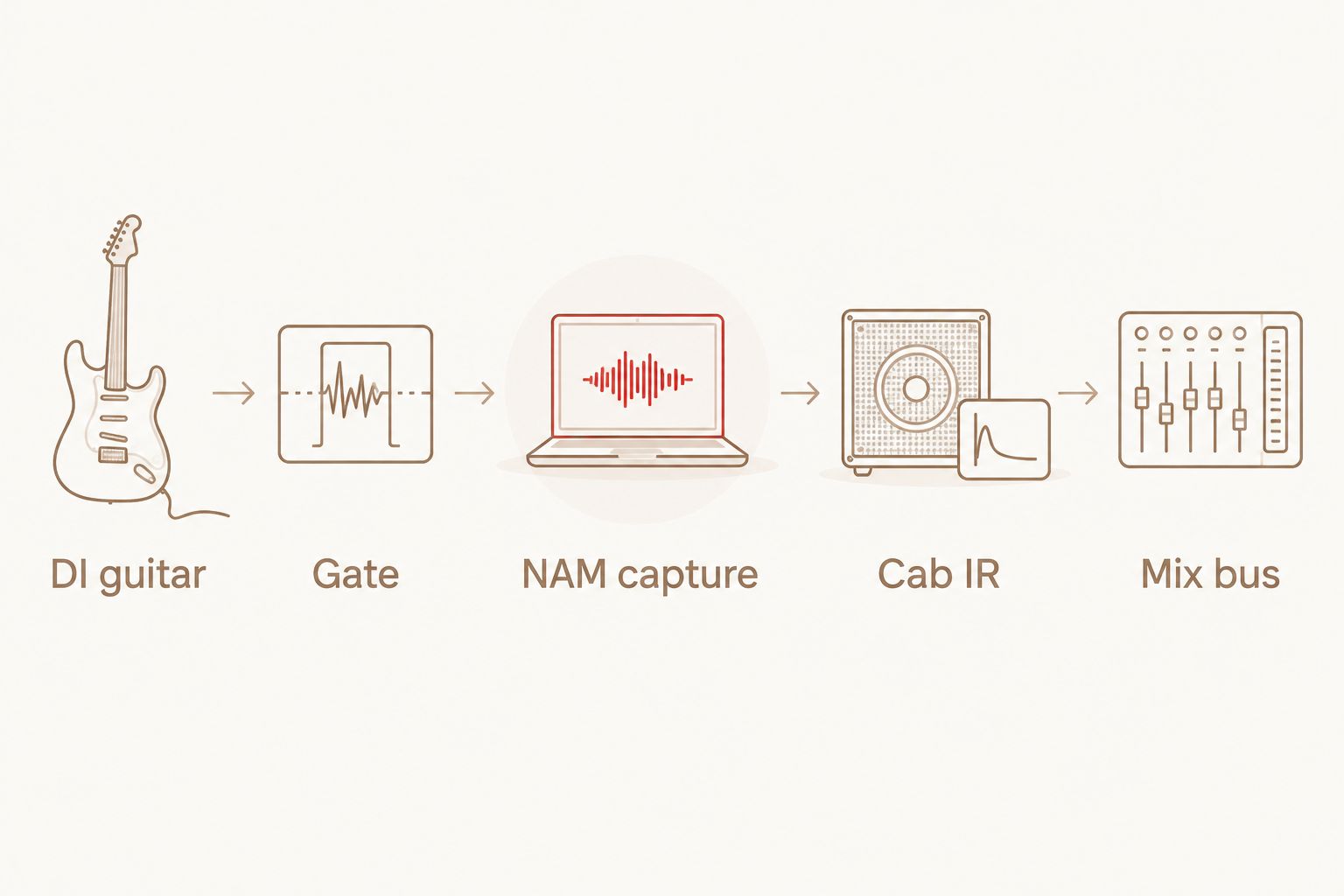
A practical chain for a DI amp capture is:
- DI guitar: Connect the guitar to a suitable instrument input and record the unprocessed performance.
- Gate: Use one if unwanted noise interrupts the part; set it against the actual pauses and note tails.
- NAM capture: Load an amp capture and compare it at a matched listening level.
- Cab IR: Add a compatible cabinet IR when the capture does not already include the cabinet sound.
- Mix bus: Listen with the bass and drums before changing the guitar EQ.
The order matters because the cabinet stage changes what reaches the mix. A raw DI amp capture without an appropriate cab IR is not a fair comparison with a microphone in front of a guitar speaker. Conversely, adding another cab stage to a capture that already includes one changes the sound twice. Check the capture documentation rather than guessing from its filename.
If you want to change the tone after tracking, preserve the dry DI alongside the monitored sound. That lets you test another capture or IR against the same performance. It also keeps tone decisions separate from playing decisions: a new sound cannot disguise loose timing, but it can reveal whether the original guitar tone was masking the bass or cymbals.
When does a real amp still win?
A real amp wins when the physical cabinet is part of the performance you want to hear or record. Standing near a loud speaker changes the player's experience in a way headphones and studio monitors do not reproduce. The cabinet, room and microphone position also form part of the recorded result; a NAM amp capture alone does not contain your particular room and mic setup.
There is a practical trade-off. An amp-and-cab recording gives you direct access to that physical interaction, but changes to the microphone position or amp controls call for another setup decision. A NAM workflow makes capture recall straightforward, but the choice of capture and cab IR becomes the setup decision instead. Neither route eliminates judgement.
For 2026 home recording, start with the outcome you need. If the goal is a controllable guitar part in a dense metal mix, test the NAM chain first. If the performance depends on hearing a specific cabinet in the room, record that cabinet rather than asking a profile to recreate the playing experience.
When do NAM profiles win for metal and hardcore recording?
NAM profiles win when you need to track a performance now and settle the final amp sound while the arrangement develops. A dry DI lets you keep the take while auditioning different captures. That is useful when the bass tone, drum programming or guitar layers are still changing, because the best isolated guitar sound is not necessarily the clearest rhythm tone in the finished track.
For high-gain parts, make these checks before adding more distortion:
- Pick attack: Can you hear the start of each chug against the kick drum?
- Palm-mute length: Do stopped notes end cleanly, or does noise blur the space between hits?
- Bass overlap: Does the guitar stay defined when the bass enters?
- Chord clarity: Can you hear the notes in a chord rather than only the distortion around them?
- Level matching: Does the preferred capture still win when both options play at a similar volume?
Oracle Sound NAM profiles are best for metal and hardcore producers who want repeatable guitar tones in a DAW; they are not a substitute for the physical response of a speaker cabinet. That is the useful verdict, not a claim that every profile sounds like every amp under every playing condition.
Which NAM setup should you try first?
Start with the recording problem, not the largest collection of tones. VIC AUDIO METAL 2 NAM is a specific option when you want to audition several high-gain amp and pedal captures with supplied cab IRs. Its listed contents are 20 DI amp captures from 10 high-gain amps, 10 pedal captures and 22 cab IRs, delivered in NAM A1 and A2 formats. Those counts describe the pack, not a guarantee that every combination will fit your track.
For a hardcore part, WVRMFOOD HARDCORE HIGH GAIN NAM PROFILES is an option whose stated focus is high-gain hardcore guitar tone. For pop-punk or emo, ALL THE SMALL TONES PUNK GUITAR TONE NAM PROFILES is described around mid- and low-gain amp sounds. Choose by the part you are recording: a heavily muted breakdown and an open, ringing punk chord do not ask the guitar tone to do the same job.
| Option | Best for | Advantage | Limitation |
|---|---|---|---|
| VIC AUDIO METAL 2 NAM | Auditioning high-gain amp, pedal and cab combinations | The pack lists separate DI amp captures and cab IRs | More choices still require careful level-matched comparison |
| WVRMFOOD HARDCORE HIGH GAIN NAM PROFILES | A hardcore-focused high-gain starting point | Its stated focus matches that use case | Genre fit alone does not tell you whether it suits your guitar part |
| ALL THE SMALL TONES PUNK GUITAR TONE NAM PROFILES | Pop-punk and emo parts needing mid- or low-gain character | Its stated gain focus differs from the high-gain options | It is not the direct starting point for a heavily saturated breakdown |
Test a short section that contains both the busiest rhythm passage and a sustained chord. If one setting handles the chugs but swallows the chord, change the capture or cabinet choice before stacking more processing. Listen at a consistent level with the rhythm section on; a louder preset can seem better without being clearer.


Why does the result vary from one session to another?
A NAM profile is only one part of the recorded sound. These factors determine whether it works as an amp replacement on your track:
- The input signal. An unsuitable recording level or an accidentally processed DI changes what reaches the capture. Check the interface input and keep a clean performance available.
- The captured setting. A capture reflects the setup used to make it. Switch captures when you need a substantially different gain character rather than expecting every amp control to be available afterward.
- The cabinet sound. The cab IR strongly shapes the top end and low-mid response. Confirm whether the capture requires a separate IR before comparing it with an amp recording.
- Monitoring. Audible delay between picking and hearing the note makes a part harder to perform. Set up direct recording and plugin monitoring so the response feels playable in your DAW.
- The arrangement. Bass, kick and cymbals change how you perceive the guitar. Make the final decision with those elements playing.
- The performance. Pick strength, muting and tuning affect the DI before it reaches any capture. Fix the source part before treating a profile change as the solution.
These checks give you a fairer test in 2026 than switching presets at random. Save a short DI passage, change one part of the chain at a time and keep playback levels comparable. The result you choose should make the riff easier to hear in the mix, not merely more imposing when soloed.
Can you record a NAM profile without a real amp?
Yes. Record the guitar through an appropriate interface input, then run the DI through a NAM-compatible loader in your DAW. Add a cab IR when the chosen capture needs one, and monitor the result while keeping the dry performance.
You still need a way to hear and judge the track. Headphones or studio monitors let you assess the recorded sound, but they do not recreate a cabinet moving air beside you. In 2026, that distinction is the boundary between replacing an amp in a recording chain and replacing the entire playing experience.
Do NAM profiles need a cab IR?
A DI amp capture needs a suitable cab IR to supply the cabinet stage of the recorded sound. A capture that already includes cabinet sound does not need the same stage added again. Check what the particular capture contains before deciding that the profile itself sounds wrong.
For a quick diagnosis, bypass the cabinet stage and listen briefly at a controlled level, then restore the intended chain. If the processed sound becomes usable only with the correct cab stage, the missing piece was not a different amp capture. This is especially relevant when comparing a direct profile with a mic'd amp track.
Are NAM profiles suitable for a finished metal mix?
Yes. A NAM profile can supply the amp sound for a finished metal guitar track when the DI performance, cabinet sound and mix all work together. The profile is not a finished mix by itself, and a high-gain setting that sounds huge alone can obscure the bass or soften rhythmic definition.
In 2026, treat the finished arrangement as the test. Play the densest section, compare options at a similar listening level and keep the version whose pick attack and chords remain clear. If neither option works, check the DI and cab stage before adding more plugins.
FAQ
Can NAM profiles replace a real amp for home recording?
Yes, NAM profiles can replace the amp stage for home-recorded guitar tracks. You still need a suitable input, the correct cabinet stage and monitoring you can play through.
Do NAM profiles sound the same as an amp in the room?
No, a NAM profile does not recreate the physical response of standing beside a loud guitar cabinet. Judge it against the recorded amp sound you need, not the sensation of playing in the room.
Do I need a cab IR with a NAM amp capture?
A DI amp capture needs a suitable cab IR, while a capture that already includes cabinet sound does not need that stage added again. Check the capture's contents before building your chain.
Can I change NAM profiles after recording guitar?
Yes, if you keep the dry DI performance, you can audition another profile without replaying the part. Match playback levels when comparing captures.
Are NAM profiles useful for hardcore rhythm guitar?
Yes, NAM profiles are useful for hardcore rhythm guitar when the pick attack and palm mutes remain clear against bass and drums. Choose the capture in the full arrangement, not from a soloed preset.
Is a NAM profile better than a mic'd amp for metal?
A NAM profile is better for quick recall and direct tone changes; a mic'd amp is better when the physical cabinet and its interaction with the player matter. Neither corrects an inconsistent guitar performance.
What should I check if a NAM profile sounds harsh?
Check whether the capture needs a cab IR and whether the correct cabinet stage is active. Then compare captures at a similar level with bass and drums playing.
One last thing
The fairest amp-versus-NAM test in 2026 starts with the same dry performance. A different take changes the picking and muting as well as the tone. Keep the DI, build the complete NAM chain, and decide whether the recorded riff does its job in the song.