

Are NAM profiles free to use with Neural Amp Modeler?
Some NAM profiles are free to download and use with Neural Amp Modeler in 2026; others are sold separately by their creators. Neural Amp Modeler is free software, but installing it does not give you every profile or permission to redistribute somebody else's files. For metal, hardcore and punk recording, check the profile's licence, capture type and cabinet requirements before building your guitar chain.
- Are NAM profiles free with Neural Amp Modeler? Some are; each creator controls the profile's distribution and terms.
- Neural Amp Modeler being free does not make every NAM profile freely redistributable.
- Oracle Sound NAM profile packs suit metal, hardcore and punk producers seeking genre-focused guitar tones.
- Check whether a NAM capture includes a cabinet before adding a cab IR.
Are NAM profiles free to use with Neural Amp Modeler?
Yes, when the creator offers the profile for free under terms that cover your intended use. Neural Amp Modeler and the profile you load are separate downloads. The software's licence does not automatically apply to an independently distributed capture.
That distinction matters in 2026 whether you are tracking a demo, delivering stems to a client or preparing a commercial release. A downloadable file is not automatically a file you can share, repackage or sell.
| Component | What it does | What you need to check | Best for |
|---|---|---|---|
| Neural Amp Modeler | Runs compatible models of captured audio equipment | Plugin format and system compatibility | Playing and recording through NAM captures |
| Creator-offered free NAM profile | Provides a capture without a purchase requirement | Usage terms, capture notes and cabinet inclusion | Trying NAM with an existing recording setup |
| Separately sold NAM profile pack | Supplies the creator's selected captures | Included files, format requirements and licence | Finding captures aimed at a particular sound |
| Cabinet impulse response | Applies the captured response of a cabinet and microphone setup | Whether the NAM capture already includes that stage | Completing an amp-only recording chain |
For the loading process, use the guide to connecting NAM profiles to Neural Amp Modeler. Choose a profile first, then build the chain around what it actually captures.
Why this matters when recording heavy guitars
A free profile can be useful and still be wrong for your session. An amp-only capture without cabinet processing can sound abrasive through studio monitors; a complete rig capture followed by another cabinet IR adds another layer of filtering.
Neither problem tells you whether the capture is good. It tells you that the signal chain needs checking. Judge the complete guitar chain, not the download label.
For tight metal rhythm tracks, listen to palm-mute definition and how the pick attack sits against the kick. For punk and emo, check whether open chords retain their separation. Those tests are more useful than auditioning an isolated sustained note and choosing the loudest result.
Free NAM profiles: best for testing your setup
Start with creator-offered free profiles when you want to learn the loader and confirm your recording chain. Load a documented capture, record a dry guitar part and establish a repeatable audition process before collecting more files.
The advantage is straightforward: you can explore different captures without committing to a particular pack. The limitation is that a free download alone tells you nothing about documentation, cabinet content or permissions.
Look for these details beside the download:
- Capture type: amp, pedal or a complete rig.
- Captured settings: the equipment configuration represented by the model.
- Cabinet content: whether speaker and microphone processing is included.
- Input guidance: any level or calibration instructions supplied by the creator.
- Usage terms: what the creator permits you to do with the file.
For a 2026 recording session, save those notes with the profile. A folder full of unnamed captures is harder to recall than a smaller library with clear signal-chain information.
Genre-focused NAM packs: best for a defined recording brief
Oracle Sound NAM profile packs are best for metal, hardcore and punk producers seeking genre-focused guitar tones. Match the pack's stated content to the part you need to record rather than treating every high-gain capture as interchangeable.
The following examples serve different briefs. Their descriptions support those distinctions, but they do not establish that either will outperform a free capture in your mix.
| NAM pack | Stated content or direction | Best for | Limitation to check |
|---|---|---|---|
| VIC AUDIO METAL 2 NAM | 20 DI amp captures from 10 high-gain amps, 10 pedal captures and 22 cab IRs; NAM A1 and A2 formats | High-gain sessions that need separate amp, pedal and cabinet choices | Confirm support for the supplied NAM formats in your loader |
| ALL THE SMALL TONES PUNK GUITAR TONE NAM PROFILES | Pop-punk and emo direction, with mid- and low-gain amps | Chord-driven punk and emo recording | Its stated direction is not the same as a dedicated high-gain metal brief |
VIC AUDIO METAL 2 NAM gives you separate building blocks: 20 DI amp captures, 10 pedal captures and 22 cab IRs. That supports an amp-and-cab audition workflow, but it also means you need to choose the combination rather than assume every file is a finished guitar chain.
ALL THE SMALL TONES PUNK GUITAR TONE NAM PROFILES targets a different production problem. Its mid- and low-gain direction is relevant when chord articulation matters more than maximum saturation.
Choose the capture direction that fits the arrangement. Neither a pack name nor the number of files proves that a tone will work with your pickups, performance and drums.
Why NAM profile availability and usefulness vary
Creators distribute different kinds of captures. These differences explain why finding a free file and finding the right recording tone are separate jobs:
- Distribution model: some creators offer free profiles; Oracle Sound sells NAM tone profile packs.
- Content scope: a download can contain an amp capture, pedal captures, cabinet IRs or a combination.
- Genre direction: high-gain metal and mid-gain pop-punk require different audition priorities.
- Cabinet workflow: DI amp captures need cabinet processing for a conventional miked-cab sound, while complete rig captures require a different approach.
- Format requirements: supplied NAM formats must be supported by the loader you use.
These are selection factors, not a quality ranking. A tightly matched capture is more useful than a large collection you cannot identify or load correctly.
How do you use a free NAM profile in a DAW?
Use the same loading process for a compatible free profile as for a separately acquired one. The file's distribution model does not change the basic recording chain.
Record the dry guitar
Connect your guitar to an appropriate instrument input on your audio interface. Record a mono DI track and keep the dry performance available for reamping.
Set the interface input so hard picking does not clip. Do not compensate for an overloaded input by turning down the plugin output; clipping already recorded into the DI remains in that recording.
Load the capture
Insert Neural Amp Modeler on the DI track and load the NAM model. Follow the creator's input-level guidance where supplied, and check whether the file represents an amp, a pedal or a complete rig.
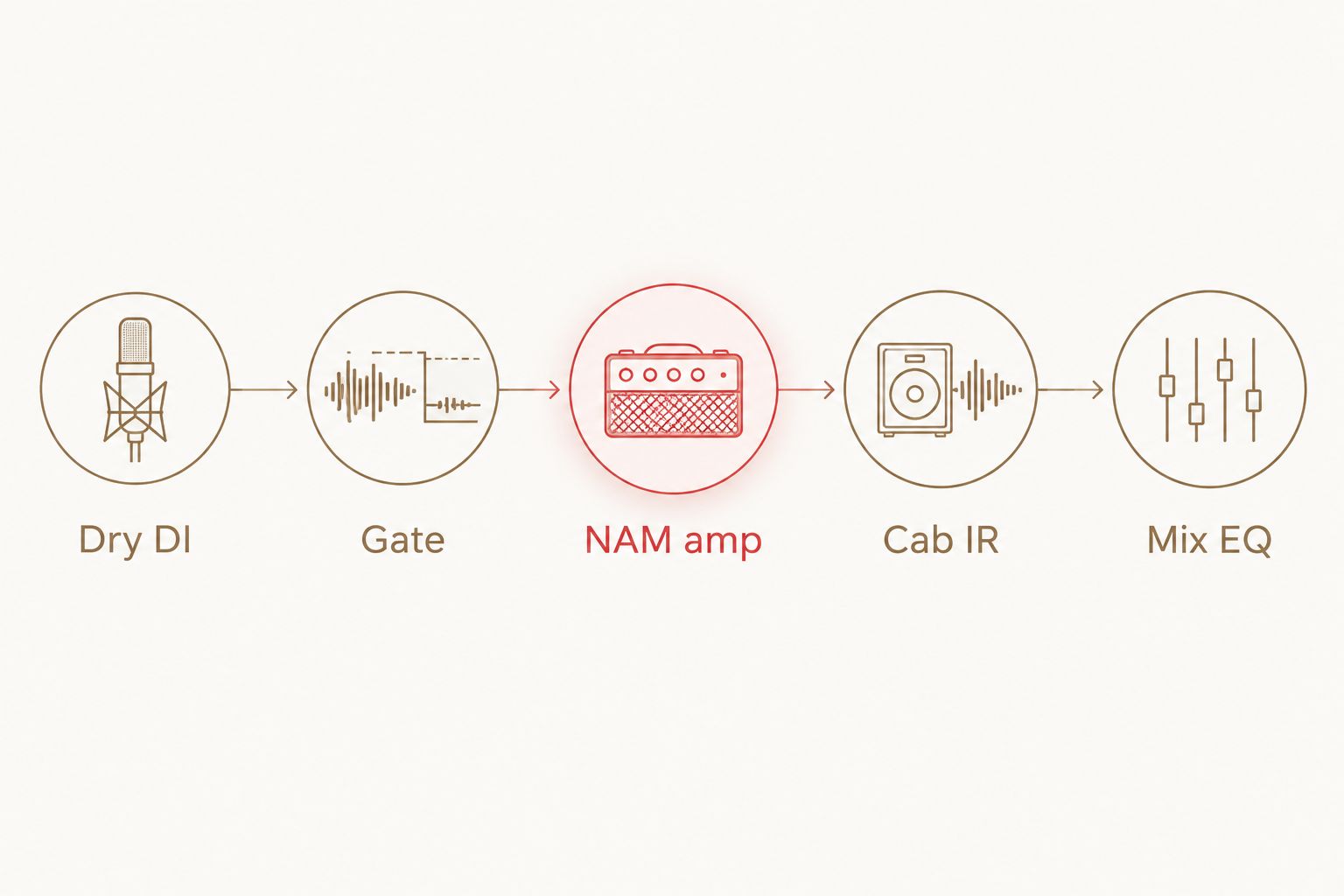
For a DI amp capture, a practical chain is Dry DI, Gate, NAM amp, Cab IR, Mix EQ. The gate is optional; use it to control unwanted noise without cutting off intended sustain.
Check the cabinet stage
Add cabinet processing when the capture requires it. If the creator describes the file as a complete amp-and-cab rig, start without another cabinet IR and listen before adding anything.
For VIC AUDIO METAL 2 NAM, the stated DI amp captures and separate cab IRs provide a clear reason to audition those stages separately. Keep the amp fixed while comparing cabinets, then keep the cabinet fixed while comparing amps.
Set the playing response
Adjust the level feeding the model only after checking the creator's guidance. Changing that level can change the distortion response; it is not merely a volume control.
Use the output level to make comparisons at similar loudness. For gates, set the threshold against the noise between phrases, then check that sustained notes and chord tails remain intact.
Audition inside the arrangement
Loop a passage containing palm mutes, open chords and a sustained note. Keep the DI, cabinet and downstream processing consistent when comparing amp captures.
Then bring in the bass and drums. A useful rhythm tone must leave room for those instruments, not just sound large on its own. In 2026, the practical test remains the recorded part in your actual arrangement.
Can you use free NAM profiles in commercial songs?
You can use a free NAM profile in a commercial song when its applicable terms permit that use. Free access does not answer the licensing question by itself.
Read the profile's licence or accompanying terms, not just the download button. Permission to record audio and permission to redistribute model files are different permissions; do not assume one includes the other.
If the terms are unclear, ask the creator before committing the profile to client work. Keep the answer with your session documentation so you can identify what was authorised.
Does a free NAM profile include a cabinet IR?
A free NAM profile does not necessarily include a cabinet IR. Check whether the download contains an amp-only model, a complete rig capture or separate cabinet files.
A cabinet IR is a separate processing component unless that response is already represented in the capture. Adding a cab IR to every profile by habit prevents a fair comparison between different capture types.
Are sold NAM profiles better than free ones?
Sold NAM profiles are not automatically better than free ones. The useful comparison is documented content, intended sound, compatibility and the result in your session.
For a 2026 shortlist, test your current profile against the exact production problem you need to solve. If chord definition is poor, check input level, saturation and cabinet choice before deciding that a different pack is the answer.
FAQ
Are NAM profiles free with Neural Amp Modeler?
Some NAM profiles are free with Neural Amp Modeler, but others are sold separately. The free loader does not include every creator's profiles or override their terms.
Is Neural Amp Modeler itself free to use?
Neural Amp Modeler is free software. Independently distributed NAM profiles have their own distribution and usage terms.
Can I use a free NAM profile on a commercial release?
You can use a free NAM profile on a commercial release when its applicable terms permit that use. Check the licence supplied by the creator rather than assuming that a free download grants every permission.
Do I need a cabinet IR with a NAM profile?
You need cabinet processing for an amp-only capture when you want a conventional miked-cab sound. A complete rig capture can already include that response, so check the capture notes first.
Can I send a NAM profile to another producer?
You can send a NAM profile to another producer only when the creator's terms permit redistribution. Permission to use a profile in a recording does not automatically permit sharing its files.
What's a useful Oracle Sound NAM pack for high-gain recording?
VIC AUDIO METAL 2 NAM is relevant when you need separate high-gain amp captures, pedal captures and cabinet IRs. Its stated content includes 20 DI amp captures from 10 high-gain amps, 10 pedal captures and 22 cab IRs.
Why does my NAM profile sound harsh through headphones?
An amp-only capture without cabinet processing can sound harsh through headphones. Check the capture type and cabinet stage before replacing the profile or applying heavy corrective EQ.
One last thing
Save the dry DI, model file reference and cabinet choice with the session. A printed guitar track preserves the sound, but those details preserve your ability to revise it.
For your 2026 session template, write down the model filename and processing order beside the guitar track. Record-ready guitar tones depend on a repeatable chain, not whether the profile came from a free download or an Oracle Sound NAM profile pack.